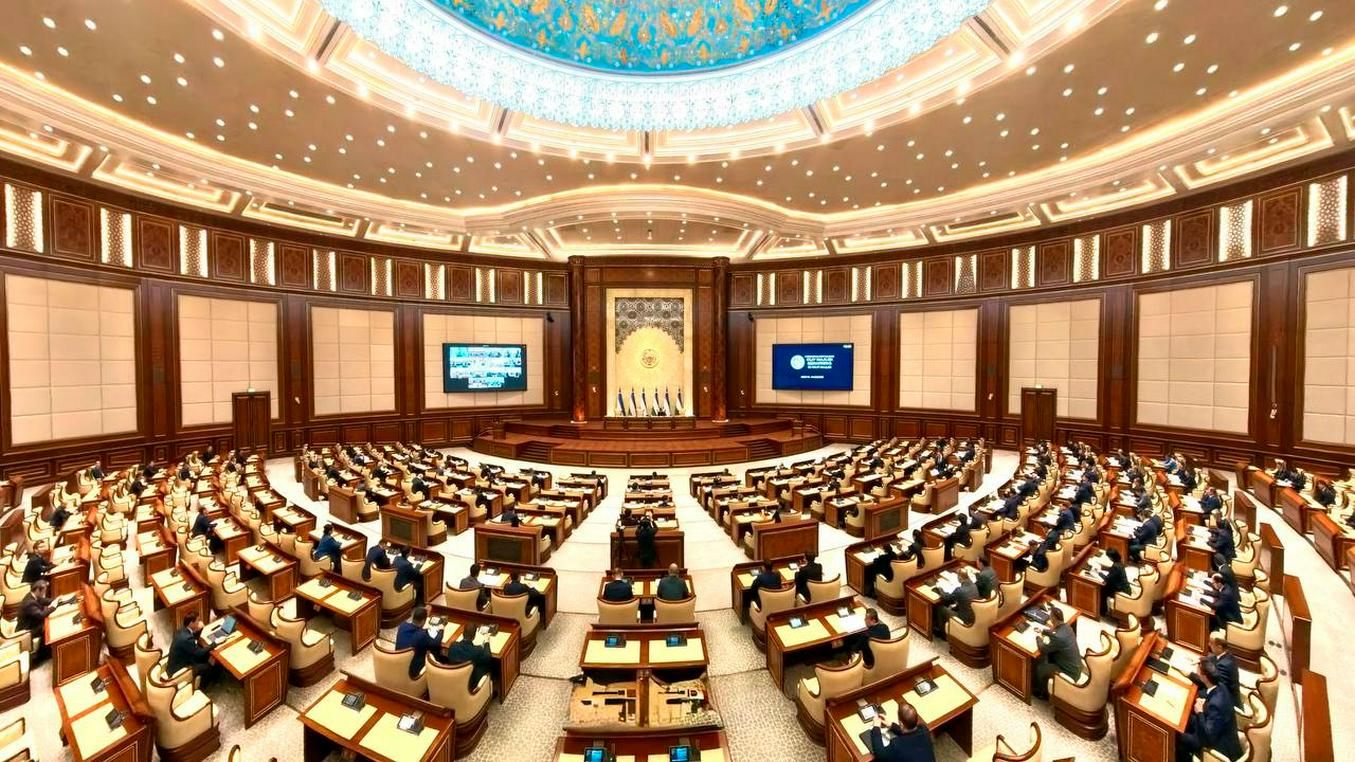
At a session on December 18, Uzbekistan’s Senate approved the law on the republic’s state budget for 2026. Under the document, 55 percent of government spending—220 trillion soums (more than $18.3 billion)—will be allocated to social support and the development of human capital next year, according to the press service of the upper house of the Oliy Majlis (parliament).
Addressing senators, Deputy Prime Minister and Minister of Economy and Finance Jamshid Kuchkarov presented the main macroeconomic indicators and fiscal policy priorities.
According to the approved budget, gross domestic product (GDP) growth in 2026 is projected at 6.6 percent. Inflation is expected to be kept within 7 percent, while GDP per capita is forecast to exceed $4,000.
Consolidated budget revenues are projected at 515.8 trillion soums (about $43 billion), with expenditures totaling 567.6 trillion soums ($47.3 billion). The consolidated budget deficit is capped at 3 percent of GDP, or about 60 trillion soums ($5 billion).
Direct state budget expenditures for 2026 are set at 402.6 trillion soums ($33.5 billion).
Education remains the top priority, with 100 trillion soums ($8.3 billion) allocated—one quarter of total budget spending. Health care will receive 49 trillion soums ($4.1 billion), an increase of 11.4 percent compared with the current year. Spending on sports will amount to 3.7 trillion soums ($308.3 million), and on culture to 4.4 trillion soums ($366.6 million).
A total of 15 trillion soums ($1.25 billion) will be directed toward improving housing conditions. Of this amount, 12.3 trillion soums ($1 billion) will be allocated for mortgage lending, and 2.7 trillion soums ($225 million) for subsidies.
Limits have been set on external borrowing to cover the budget deficit and finance projects. Borrowing to cover the deficit is capped at $2.5 billion, with an additional $2.5 billion earmarked for investment projects.
The maximum net volume of government securities issuance is set at 30 trillion soums ($2.5 billion), while the maximum value of new public-private partnership projects is capped at $6.5 billion.
Special attention is given to regional development and civic initiatives. The “Initiative Budget” program will receive 6 trillion soums ($500 million), including funding for projects proposed by deputies. Beginning in 2026, 5 percent of value-added tax revenues will remain in Tashkent’s city budget, while 20 percent will be retained by the budgets of Karakalpakstan and the regions. As a result, regional authorities will have access to 4.3 trillion soums ($358 million).