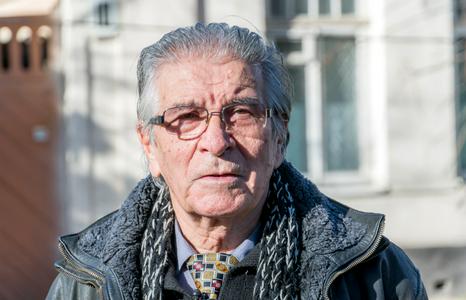
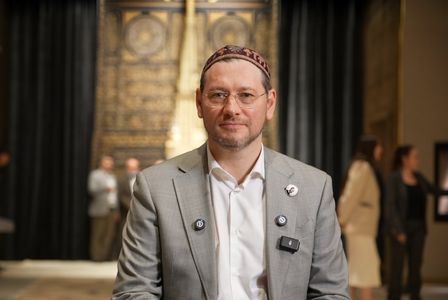
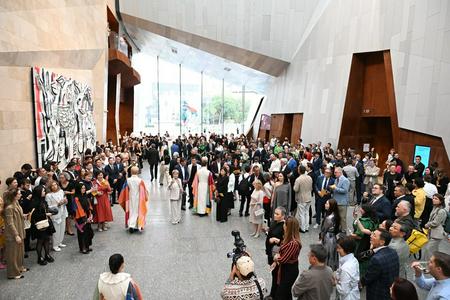
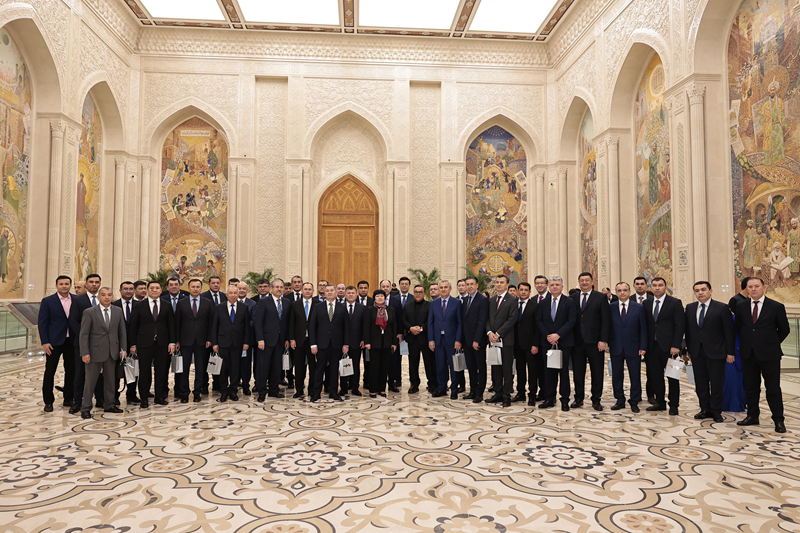
 Uzbek ambassadors at the Center for Islamic Civilization. Photo: cisc.uz
Members of the diplomatic corps, including around 60 ambassadors of Uzbekistan from countries around the world, visited the Center for Islamic Civilization in Tashkent, according to the Center’s press service.
The tour was personally led by the Center’s director, Dr. Firdavs Abdukhaliqov, who подробно outlined the concept behind the complex as well as the historical, scholarly, and spiritual heritage embodied in its museum exhibitions. In his welcoming remarks, Abdukhaliqov thanked the Ministry of Foreign Affairs and Uzbek embassies for their assistance and involvement in returning to the country artifacts related to Uzbekistan.
“The Center for Islamic Civilization in Uzbekistan was built on the initiative of President Shavkat Mirziyoyev. We were tasked not only with creating an architecturally impressive structure, but also with establishing a high spiritual platform where form and content complement one another harmoniously. In this process, your support became a decisive factor. With the practical assistance of the Ministry of Foreign Affairs, overseas embassies, and their staff, we have been carrying out systematic work to return artifacts from around the world to their homeland. In 2025 alone, as a result of these efforts, about 2,000 artifacts and manuscripts were brought back to Uzbekistan from abroad and have taken their rightful place in the Center’s exhibitions. We express our sincere gratitude to the Ministry of Foreign Affairs, all embassies, and their staff for their practical support.”
During the visit, guests were introduced to the Center’s Hall of Glory as well as the building’s distinctive architectural solutions. The delegation then toured the museum exhibitions dedicated to the pre-Islamic period, the First and Second Renaissances, the section titled “New Uzbekistan: The Foundation of a New Renaissance,” the Hall of the Holy Quran, and the children’s exhibition spaces.
Furkat Siddikov, Uzbekistan’s ambassador to the United States, noted that the Center’s collection surpasses many U.S. museums in both richness and presentation.
“I have visited many museums in America, including in Washington. However, in terms of the richness of the exhibits, the depth of content, and the level of presentation, this Center, without exaggeration, surpasses them. What diplomats spend years trying to convey, a person can feel and understand after visiting this Center just once. I believe this project is of enormous importance for educating future generations. I am confident the Center will become one of the most visited places in Central Asia. It is a source of pride not only for foreign visitors, but for us Uzbeks as well,” Siddikov said.
Uzbekistan’s ambassador to the United Kingdom, Ravshan Usmanov, emphasized the importance of bringing the country’s rich historical and spiritual heritage together under one roof.
“I would like to particularly note that our embassy and the Ministry of Foreign Affairs made their contribution to the creation of this complex. Specifically, we were directly involved in locating, acquiring, and delivering to Uzbekistan a number of valuable artifacts that had been kept abroad. Today, their finest examples are presented here. The idea of uniting Uzbekistan’s rich historical and spiritual heritage under one roof is an extremely important and timely initiative. It showcases the priceless legacy of our country, the unique achievements of the entire region, and of Muslim civilization as a whole,” Usmanov said.
Uzbekistan’s ambassador to Malaysia, Karomiddin Gadoyev, said that visiting the Center filled him with pride in belonging to the Uzbek people.
“Everyone who enters here, step by step, senses the path of development of the Uzbek people, from the Stone Age to the era of New Uzbekistan. I admit that, as someone from the academic sphere, I know the history of our country well and have seen many museums. But one question always concerned me: why do we not have a large-scale complex like the Louvre in Paris or the Hermitage in St. Petersburg, where history is presented in a comprehensive and systematic way? Today, I found the answer to that question here. Being in the Center, I felt proud to be the son of a great people. I am confident that after its opening, the Center will become a favorite place not only for local residents, but also for tourists from neighboring countries and farther abroad, contributing to the growth of Uzbekistan’s international standing,” Gadoyev said.
Uzbekistan’s ambassador to Saudi Arabia, Nodirjon Turgunov, noted that the complex is equally engaging for people of all ages.
“While working in Saudi Arabia, we cooperated with the Center on the creation of the ‘First Renaissance’ section, so this hall was of particular interest to me. Seeing how the results of your work serve people is, in my view, the highest form of recognition,” Turgunov said.
Oybek Shakhavdinov, Uzbekistan’s ambassador to Hungary and Serbia, described the complex as a model of integrity and harmony.
“The Center truly impresses with its scale and content. It evokes a sense of pride in every citizen of Uzbekistan. It is especially encouraging that it is already attracting significant interest from foreign partners. For example, after visiting the Center, the president of Serbia instructed that a group of experts be sent to study its concept and the experience of its creation. This work is already underway. Such interest will undoubtedly grow from other countries as well, because a center of this level and substance exists today only in Uzbekistan. In terms of content, technology, design, and concept, it is a model of harmony and integrity. It is precisely the diligence, responsibility, and high level of dedication of our people that made the creation of such a unique center possible,” Shakhavdinov said.
ℹ️ The Center for Islamic Civilization has been built in Tashkent near the Hast-Imam complex. Designed in the style of medieval architectural monuments, the building features four portals, each 34 meters high, and a central dome rising to 65 meters. The complex includes a Hall of the Holy Quran, a 460-seat conference hall, and a museum whose exhibitions cover the entire history of Uzbekistan, from the pre-Islamic period to the present day. The Center is intended to serve as a platform for studying the legacy of past generations and for its contemporary interpretation in cooperation with the International Islamic Academy of Uzbekistan and research and educational centers around the world. The opening of the Center is scheduled for spring 2026.