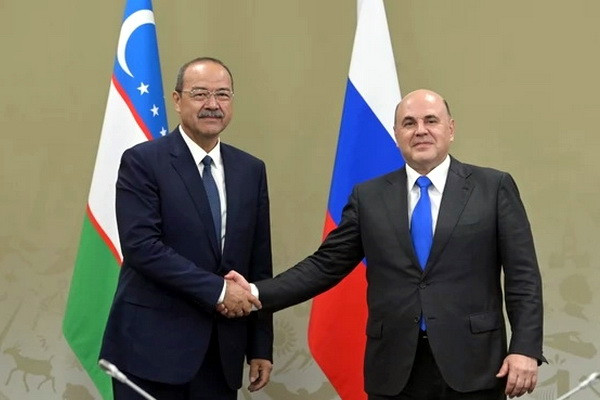
 Abdulla Aripov and Mikhail Mishustin
Russia and Uzbekistan recorded growth in trade and investment at recent talks between Prime Ministers Mikhail Mishustin and Abdulla Aripov, backing energy — above all the nuclear power plant in Jizzakh — along with industrial cooperation and humanitarian ties as the pillars of what both sides call their «comprehensive strategic partnership and alliance."
Russia's government website published the full texts of the two leaders' statements following the session of the Joint Intergovernmental Commission.
Mishustin's Key Points
Mishustin stressed that despite «geopolitical turbulence,» bilateral economic and investment cooperation is expanding: trade turnover rose roughly 12.5% in 2025, approaching 1 trillion rubles, and the two presidents have agreed it should grow «manifold» by 2030. Russia, he noted, ranks among Uzbekistan's top trading partners, with sectoral ministries, the intergovernmental commission and regional authorities all maintaining active working ties.
Energy was singled out as the flagship area of cooperation. Construction of an integrated nuclear power plant to a Russian design has already begun in Jizzakh region, with concrete work launched in March — a project Moscow frames as a long-term guarantee of energy security for Uzbekistan's economy and social sector. Russian oil and gas supplies are also continuing and expanding, with Russia involved in drilling new wells and modernizing processing and gas-pipeline infrastructure.
Mishustin also ran through Russia's investment portfolio: around 150 projects worth more than 4 trillion rubles are under way in Uzbekistan, spanning energy, light and chemical industries, mining, metallurgy, pharmaceuticals, telecoms, logistics, retail and infrastructure, including digital ventures. He highlighted the launch of the third copper-concentration plant at the Almalyk Mining and Metallurgical Complex (AMMC) and preparations for a fourth, the creation of a railway engineering cluster producing freight cars, locomotives and rolling stock for the Tashkent metro, and the operation of the Chirchiq and Jizzakh industrial parks, which are expected to generate around 3,000 jobs.
On the humanitarian front, Mishustin pointed to forums, festivals, Days of Culture and Russia's largest overseas network of university branches in Uzbekistan — including Moscow State University, MGIMO and MEPhI — enabling local students to study to Russian academic standards. He tied all of this to the broader task of deepening cooperation within the CIS, the Eurasian Economic Union (where Tashkent holds observer status), the SCO and other multilateral formats, emphasizing their «practical returns» for businesses and ordinary citizens.
Aripov's Key Points
Aripov opened by thanking the Russian side for its traditionally warm hospitality and conveying President Shavkat Mirziyoyev's greetings to Vladimir Putin and Mikhail Mishustin. He declared that Uzbek-Russian relations of strategic partnership and alliance had «reached a fundamentally new level,» attributing the momentum to the strategic course set by both countries' leaders. He described the intensifying contacts between governments, agencies and regions: 14 Uzbek regions now interact with more than 50 Russian federal subjects, a council of regional heads has convened, and over 100 reciprocal visits have taken place.
On the economic figures, Aripov went further than his Russian counterpart: bilateral trade has doubled over the past five years, he said, surpassing $13 billion in 2025, and in the first months of 2026 it grew by a further 30%. The agreed target is $30 billion by 2030, to be reached by broadening the range of goods traded and raising the share of high-value-added products.
Aripov reported that more than 3,200 enterprises with Russian capital are operating in Uzbekistan, the joint project portfolio is valued at nearly $44 billion, and roughly $5 billion in Russian investment had been deployed by 2025. Cooperative projects are in development across mining and metallurgy, energy, chemicals, agriculture, textiles, electrical engineering, digitalization and artificial intelligence.
He, too, cited progress at the AMMC and the Tashkent metro fleet overhaul, and highlighted the development of industrial parks in Tashkent, Jizzakh, Bukhara and Navoiy regions. The overarching goal, he said, is to sustain the current momentum, scale up trade and investment, and bring major infrastructure and industrial facilities on stream — including through Russia's participation in the Innoprom exhibition in Tashkent and the Tashkent International Investment Forum.
On energy, Aripov underscored that the first nuclear power station would mark «a new chapter,» making Uzbekistan the first country to host both a small modular reactor and a full-scale nuclear plant on a single site. On transport and logistics, he cited a sharp rise in freight volumes and a record 367 scheduled flights per week between the two countries — a figure unmatched, he said, on any of Uzbekistan's other international routes.
In the humanitarian sphere, Aripov listed cultural, tourism, scientific and youth exchanges, as well as cooperation in secondary and higher education and healthcare. Fifteen branches of Russian universities are already operating in the country, he said; nearly one million Russian tourists visited Uzbekistan in 2025; Days of Russian Culture and Russian Cinema were held; and Days of Uzbek Culture in Russia are planned for autumn 2026 as a symbol of «deep mutual understanding and respect."
He closed by affirming that Tashkent is «firmly committed» to further developing mutually beneficial cooperation with Russia, adding that ministers would report on specific projects and prospects. The session concluded with the signing of a joint communiqué enshrining its outcomes and agreements.