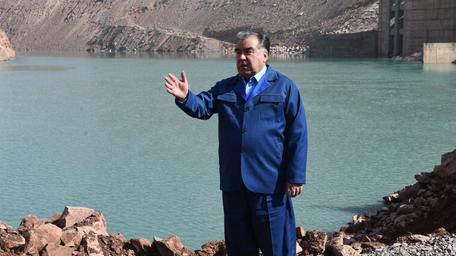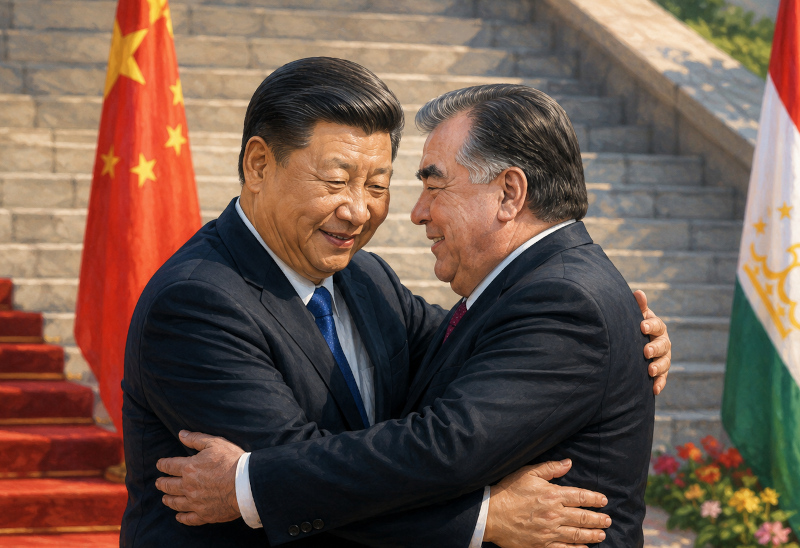
From May 11 to 14, Tajikistan's President Emomali Rahmon is paying a state visit to Beijing at the personal invitation of Chinese President Xi Jinping. The visit was announced by China's Foreign Ministry spokesperson and confirmed by the Tajik foreign policy agency — the highest protocol format in bilateral diplomacy, entailing full ceremonial honours, top-level negotiations, and the signing of a package of documents.
This trip marks the fifteenth visit in the history of Tajik-Chinese relations. Rahmon's first official visit to the PRC took place in March 1993, shortly after the Soviet collapse, when the foundations of bilateral cooperation were being laid. He has since visited China in 1996, 1999, 2001, 2003, 2007, 2012, 2013, 2014, 2015, 2017, 2018, 2019, and 2023. Chinese leaders have returned the gesture with visits to Dushanbe in 2000, 2008, 2014, 2019, and 2024. The cumulative frequency of these exchanges makes clear that Beijing has long become Tajikistan's primary foreign policy and economic anchor.
According to the Tajik Foreign Ministry, negotiations will cover a broad range of bilateral issues — political, trade-economic, investment, and humanitarian. Three priority areas will receive particular attention: energy, the green economy, and digital technologies — sectors Beijing is actively advancing across Central Asia through the Belt and Road Initiative. The summit is expected to conclude with the signing of a new package of agreements that will, in official parlance, «significantly expand the legal framework» of the bilateral relationship.
The backdrop to this visit is sobering. Tajikistan is Central Asia's poorest country and carries a substantial debt burden toward China: Beijing's Export-Import Bank alone holds over $700–800 million of Dushanbe's external debt — more than a quarter of the total and the largest single-creditor position. As partial repayment, China has already secured concessions to operate several mining facilities on Tajik territory.
In 2025, for the first time in more than two decades, China overtook Russia as Tajikistan's largest trading partner, with bilateral trade reaching $964 million in just the first five months of the year — a 30 percent year-on-year surge. Beijing now also outpaces Moscow as Tajikistan's biggest foreign investor and creditor. The previous Rahmon–Xi meeting took place in September 2025 in Beijing on the sidelines of the SCO summit, preceded by a June 2025 encounter at the «Central Asia – China» summit in Astana — three meetings in under a year, an unusual pace even by the standards of the Tajik-Chinese partnership.
Official Dushanbe reads the dense diplomatic calendar as proof of a «comprehensive strategic partnership» elevated to a «new level» following Xi Jinping's 2024 state visit to Tajikistan. Critics offer a starker reading: the deeper the debt hole, the more frequently Rahmon must make the journey to Beijing.