 Photo: Repost.uz
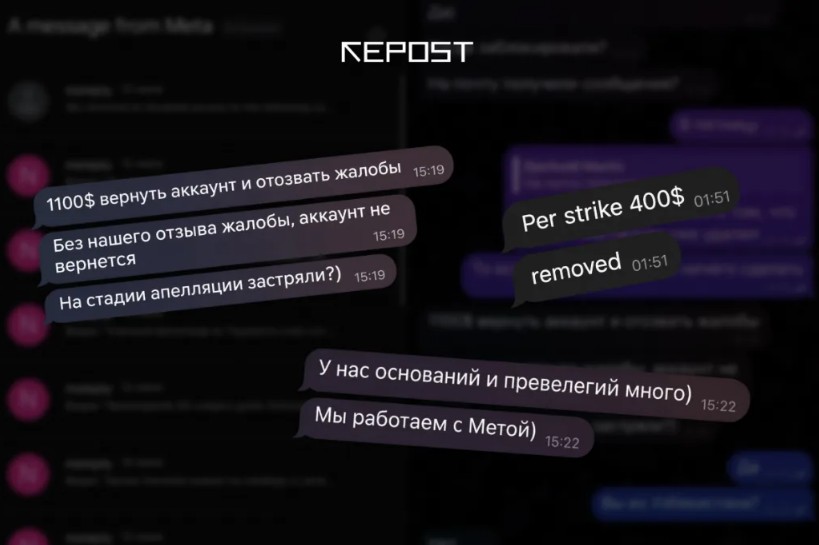
Uzbek online news outlets Repost.uz, Pressa.uz, and Oblako.uz have fallen victim to scammers who orchestrate the removal of social media posts before demanding ransom to retract fraudulent copyright complaints. In several instances, extortionists received payments, after which the claims were swiftly dropped, Repost.uz reports.
The fraudsters exploit copyright protection systems on Instagram and Facebook. Posing as rightful rights holders, they lodge infringement complaints against news videos and other editorial content. Social media platforms often take down the targeted posts and place restrictions on the accounts. A rapid succession of such strikes risks permanently shutting down pages that reach hundreds of thousands of followers.
Copyright infringement notifications typically list contact information for the claimants. When editorial staff attempt to resolve the issue, the individuals demand payment to withdraw their complaints. Affected outlets report that once ransoms were paid, individual strikes were lifted within minutes. However, the publications did not disclose who among them paid the extortionists or what sums were transferred.
In some cases, the perpetrators offered to reinstate already blocked accounts for an extra fee, claiming to have connections with social media insiders. No evidence supports these alleged ties, however. It remains unproven whether the restoration of access following payment resulted from intermediary actions or merely coincided with standard automated review processes.
The attacks target both editorial reporting and commercial advertising created in-house or provided by sponsors. Deleting sponsored material exposes outlets to financial losses and breaches of contract with advertisers. The affected media organizations noted recurring patterns across claimants’ email addresses, complaint wording, and payment requests. While these similarities suggest a coordinated campaign, a definitive link connecting the incidents has yet to be established.
A nearly identical extortion scheme was exposed by the BBC on September 8, 2026. The investigation detailed how popular Instagram creators were threatened with bans through fraudulent copyright claims. One victim, managing an account with 1.5 million followers, transferred $50 in cryptocurrency to regain access, only to be targeted again soon after.
During its investigation, the BBC spoke with three individuals who admitted to filing copyright strikes despite having no legal rights to the content. Meta told the British broadcaster that it had reinstated the removed posts and implemented additional safeguards for affected accounts. Cybersecurity experts strongly advise victims against paying ransoms, warning that giving in guarantees neither an end to the strikes nor protection from subsequent extortion attempts.
Moreover, on August 28—prior to the BBC report—eight independent Azerbaijani news organizations issued a joint statement detailing similar abuses. Signatories included Abzas Media, Meydan TV, Toplum TV, Qəzet.i, Mikroskop Media, Azadlıq Qəzeti, HamamTimes, and Azərbaycan Saatı. By then, fraudulent copyright complaints had already led to the suspension of several outlets' pages across Instagram and Facebook.
Azerbaijani journalists cross-referenced incoming complaints and discovered matching email addresses, claimant details, and filing patterns, condemning the actions as a coordinated campaign to suppress the independent press. They jointly urged Meta to investigate the origins of the strikes, verify claimants, and restore disabled accounts. The outlets also sought support from international media watchdogs and digital rights groups. Unlike the Uzbek outlets, the Azerbaijani newsrooms did not report ransom demands.
Consequently, by the time Uzbek media outlets were targeted, the mechanics of this extortion scheme had already been documented extensively by international press. Nonetheless, coverage by Repost.uz, Pressa.uz, and Oblako.uz made no reference to the BBC investigation or to the experiences of their Azerbaijani peers.
Whether the attacks on Uzbek newsrooms are connected to the extortionists profiled by the BBC or to the coordinated strikes against Azerbaijani outlets remains unknown.