 Photo courtesy of oblako.uz
Uzbekistan’s Ministry of Justice has released a draft government resolution outlining the country’s transition to an updated Latin alphabet for public consultation. The changes will affect official identity documents, the education system, mass media, commerce, and digital services, Gazeta.uz reports. The public review period runs through December 6.
Under the draft regulation, starting April 22, 2027, national ID cards, international passports, driver's licenses, vehicle registration certificates, and land registry records will be issued using the new letters. Previously issued documents will retain full legal force, and existing blank forms may be used until January 1, 2028. Discrepancies in the spelling of names and surnames will not serve as grounds for refusing public services.
In the education sector, the transition will take place over several years. Textbooks for grades 1 through 11 are scheduled for revisions between 2027 and 2031, with first-graders receiving new instructional materials in the 2027–2028 academic year. Older students will receive temporary leniency on orthographic grading, including on final school and university entrance exams.
A dedicated adjustment period is planned for businesses. From April 2027 to April 2028, manufacturers may use both old and new spellings concurrently on product packaging. Thereafter, the updated alphabet will become mandatory for newly ordered packaging and labels. Pre-printed packaging materials may be used until April 2029.
The transition will also reshape public spaces. Authorities plan to phase out and replace signs on shops, retail and service outlets, informational plaques, street signs, transit stops, and displays across public transportation hubs. However, immediate universal replacement is not required. Existing geographical signs may remain until worn out or until deadlines set by official programs. Specific deadlines for replacing commercial storefront signs have not yet been set.
The draft also mandates that news outlets and publishers switch to the updated alphabet once the law takes effect. While the rules apply to private editorial boards, it remains unclear whether they may continue publishing Uzbek-language materials in Cyrillic. Penalties for non-compliance are not specified in the document.
The reform will extend to banking applications, payment terminals, and state information systems. Authorities plan to establish a unified standard for the Uzbek keyboard layout and ask tech companies, including OpenAI, Google, Anthropic, and Meta, to adapt their artificial intelligence models to the new spelling rules.
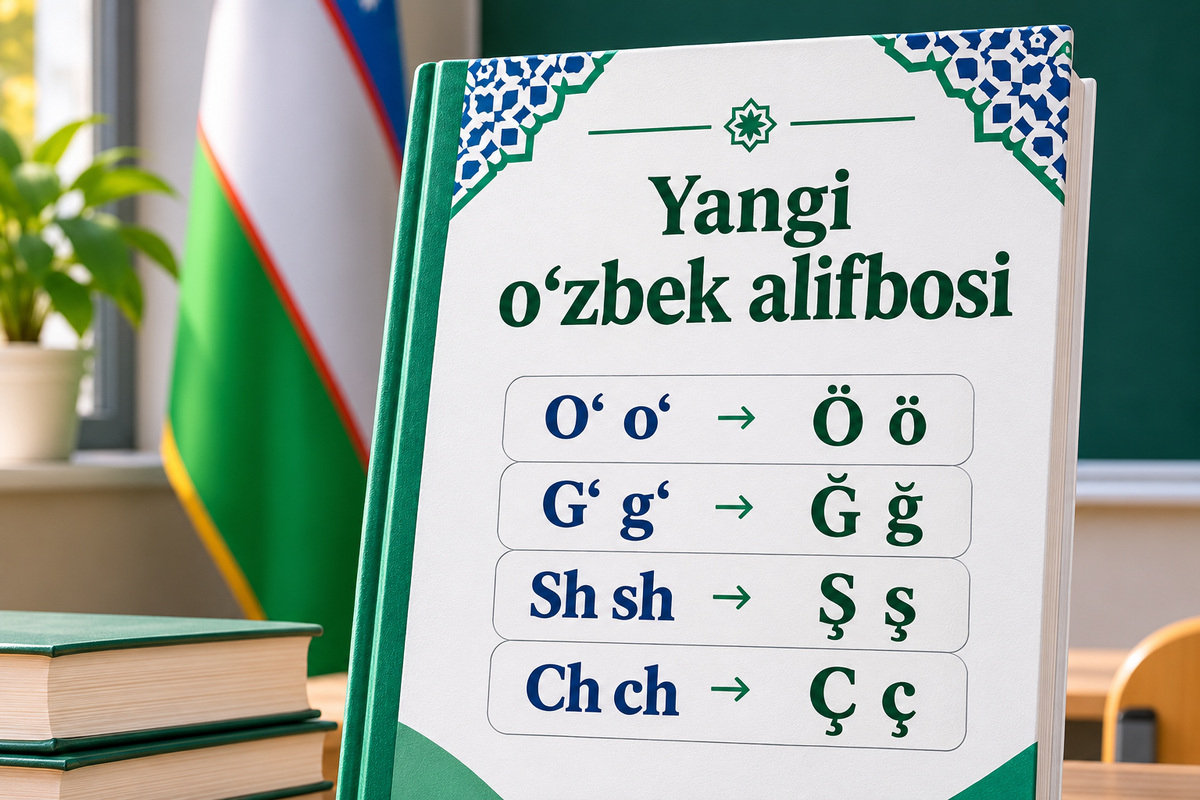
President Shavkat Mirziyoyev signed the law modernizing the alphabet on October 21, 2026. As Fergana previously reported, Uzbekistan’s transition to the Latin script began in 1993. Two years later, the original alphabet was modified, replacing several diacritical letters with digraphs and apostrophes. The current reform reinstates four distinct letters—Ö, Ğ, Ş, and Ç—in place of O‘, G‘, Sh, and Ch. The finalized alphabet will comprise 28 letters and one apostrophe. The law takes effect on April 22, 2027.