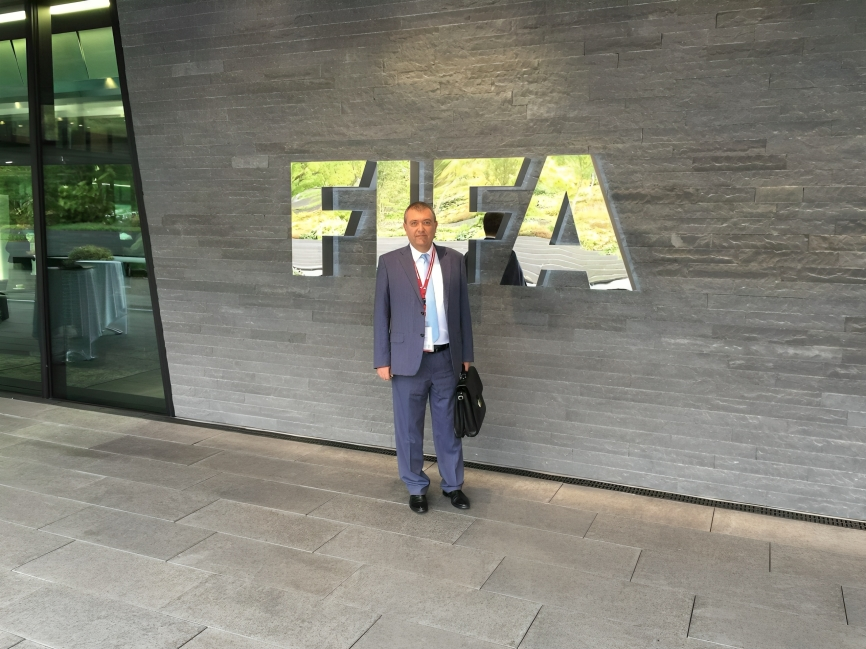
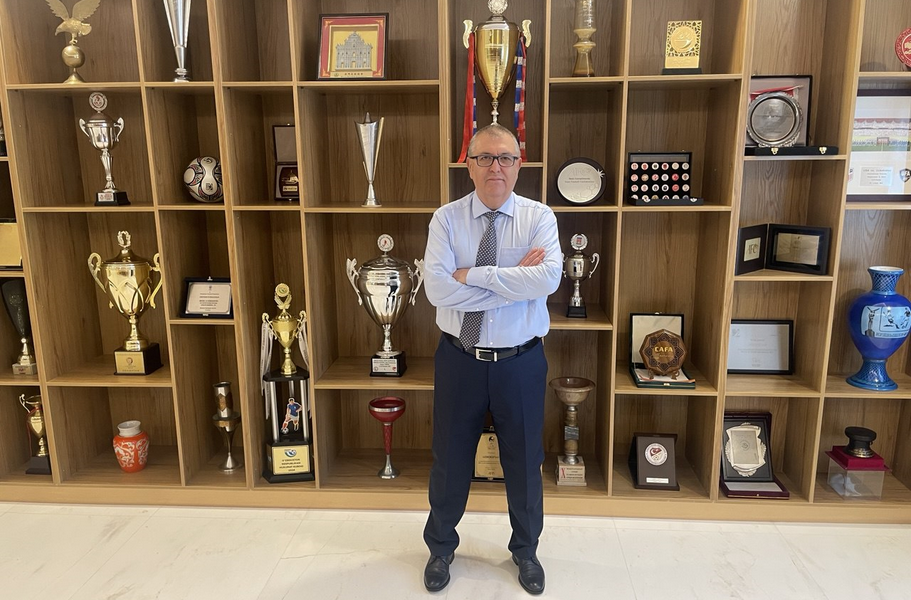
 Alisher Aminov. Photo courtesy of Alisher Aminov's personal archive
Gianni Infantino has announced he will seek another term as president of FIFA in 2027. He was elected unopposed in both 2019 and 2023. If re-elected, his tenure at the helm of world football's governing body will reach fifteen years.
Analyst Alisher Aminov — an international expert in economics and law, a FIFA expert, a former candidate for the presidency of the Russian Football Union, and a candidate of economic sciences — explains what this means for FIFA and the game at large.
The «New FIFA» and the Concentration of Power
Under FIFA's statutes, a president's term in office cannot exceed twelve years. Yet CONMEBOL, CAF and the AFC have already endorsed Infantino's re-election bid, giving him a reliable base of 54 African votes, 47 Asian votes and 10 South American votes — more than enough to prevail.
Infantino came to power promising reform, transparency, accountability and a «new FIFA.» A decade on, the organisation is defined by political short-sightedness, weakened oversight and a growing dependence on state power at the highest level. The upshot is this: FIFA no longer commands the influence it once did, and its president sometimes cuts a faintly absurd figure alongside the President of the United States.
The Infantino administration was discredited from the very first congress in Mexico City, when he appointed a Secretary General in defiance of established rules — without any public consultation or proper vetting. At the same congress, he stripped FIFA's Ethics Committee of its independence, replacing independent judges and investigators with figures he could appoint and deploy as he saw fit.
The 2017 FIFA Congress in Bahrain made this explicit: Cornel Borbély and Hans-Joachim Eckert, chair of the Ethics Committee's adjudicatory chamber, were removed from their posts. Both had been central to FIFA's post-2015 reform process; their dismissal was widely condemned as politically motivated.
This was a cynical weaponisation of FIFA's own judicial machinery. Democratic debate has no place in today's FIFA. Two fundamental problems dominate: a political cartel with a dangerous concentration of power, and the absence of any effective independent oversight.
So much for the «new FIFA.» So much for the promise that the whole world would applaud.
At the congress, Infantino pledged that FIFA would exceed its $14 billion revenue target for the 2027–2030 cycle. The organisation's commercial firepower has allowed him to consolidate near-total control, despite a string of serious corruption scandals and systematic regulatory violations over his ten years in charge. In all likelihood, he will again face no challenger.
In these early days of May, one might hope that old Europe would come to understand what kind of governance crisis FIFA and its continental confederations have created — nurtured quietly in the comfort of the Swiss Alps. It hasn't yet. But at some point, the reckoning will arrive even for the collective Infantino.
Trump, Saudi Arabia and a Crisis of Credibility
Infantino's presidency has attracted sustained controversy, not least over the award of the 2034 World Cup to Saudi Arabia. In recent months, his relationship with Donald Trump — and his decision to present the US president with FIFA's inaugural «Peace Prize» — has drawn sharp criticism from within the organisation and far beyond it.
His management style raises deepening concerns. A telling anecdote: FIFA reportedly submitted a formal request to Canadian police to afford its president fourth-level security status — meaning long motorcades and the right to pass through red lights. When this became public, FIFA attempted damage control by claiming Infantino had nothing to do with the request and had in fact wanted to travel around Vancouver by public bus. Either way, the episode fits perfectly into the public's perception of Infantino: the FIFA president appears to regard himself as no less infallible than the head of the Catholic Church.
In 2027, Infantino will stand for election to a third and, under the current — though always amendable — statutes, final term. But anxiety in the presidential camp is already palpable; the campaign has begun.
The 2027 elective congress was awarded to Morocco, a country with particularly close ties to Infantino. Discontent with FIFA's ruler has reached a tipping point, and his proximity to Donald Trump has become a liability.
In African football politics — where Infantino's trusted lieutenants have held sway for years — fissures are appearing. A growing number of people are wearying of Zurich's patronage.
The line between morality and legality can be vanishingly thin. Consider the 2026 Africa Cup of Nations final between Senegal and Morocco: the referee allowed the match to continue and Senegal was proclaimed champions on the field, but CAF's appeals body overturned the result on legal grounds.
FIFA needs to shed its crown at a moment when African, Asian and European football are all under pressure from a global crisis.
In Europe, the FIFA boss already enjoys little credibility. And it is precisely in this context that Infantino and FIFA's leadership are falling back on the oldest playbook in sports politics: more money for the football community.
The rhetorical question answers itself. The key outcomes of this era are plain to see: an open conflict between the presidents of FIFA and UEFA; an unprecedented war between European leagues, club associations and federations; an excessively cautious and inconsistent stance from FIFPro's leadership; and the complete impotence of European coaches' and referees' associations within FIFA's decision-making structures.
FIFA as a Political Cartel
The global football system is not a professional community of football stakeholders. It is a political cartel. Its existence and survival rest on opacity, and on the systematic disregard for rules, regulations and law.
Double standards, the absence of independent judicial bodies, corruption scandals, criminal prosecutions and the arrest of confederation and association officials have become routine features of its operation.
There is a certain logic to this. The modern FIFA and its confederations have commercialised football to such a degree that national associations have, in effect, nowhere else to go — and no desire to go anywhere. For them, the financial injections from FIFA's revenues are a genuine narcotic. The addiction is nearly impossible to break.
While fans at this World Cup are bleeding financially — forced to pay record sums for tickets and accommodation — FIFA is distributing additional millions to its member associations, and therefore to the individuals within national federations who control those funds.
These, of course, are the very people whose votes will determine whether Gianni Infantino is re-elected. Before the congress, a plan was reportedly discussed among FIFA members under which all national association presidents would in future receive direct compensation from FIFA.
Today, more than three dozen senior officials on the FIFA Council already draw princely salaries. Infantino himself earns approximately $6 million a year, while the other 37 members of his council receive up to $250,000 annually.
Their job is to attend a handful of council meetings in luxurious surroundings and nod politely at whatever Infantino and the FIFA administration place before them. One in every six FIFA member associations already has an official receiving a substantial sum directly from FIFA. Soon, all 211 association presidents will be eligible for grants.
FIFA's leadership distributes its largesse elsewhere, too. Development funding plays a central role in the FIFA ecosystem — though questions sometimes arise about precisely how and on what it has been spent in certain countries.
The question remains open: will all this money prove sufficient to generate applause and contain the anxiety within FIFA's generously compensated upper echelons?
The World Cup as a Revenue Machine
A month before the World Cup and on the eve of the FIFA Congress in Vancouver, President Infantino showered participating associations with money — to allay financial concerns, to «unite» the football family, and to shore up his position ahead of next year's election.
In recent years, FIFA has repeatedly revised its revenue projections upward. According to its latest financial report, the world governing body will generate $13 billion over the current four-year cycle, with almost $9 billion of that coming in this year alone.
It is almost hard to believe that the 2010 tournament in South Africa generated $4.19 billion. By the end of this summer, FIFA's revenues are projected to have grown by 73 per cent compared with the 2018 World Cup in Russia, and 18 per cent compared with Qatar in 2022. In its most recent financial report, FIFA increased its budget for the next four-year cycle to $14 billion, having already exceeded its 2022–2026 revenue targets.
Broadcasting rights remain FIFA's most lucrative revenue stream. Income from broadcast deals is expected to rise from $3.4 billion in Qatar and $3.1 billion in Russia to $4 billion for the current tournament.
FIFA's decision to expand the World Cup from 32 to 48 teams has been central to this growth. With the number of matches increasing from 64 to 104, FIFA has far more content to sell to broadcasters, and kick-off times that are considerably more attractive to the lucrative North American and European markets than four years ago.
FIFA has also introduced several notable innovations that have unlocked additional broadcast revenue — selling the Women's World Cup rights as a standalone property, and monetising social media by selling streaming rights for the first ten minutes of matches to TikTok and YouTube, a move designed to draw younger audiences.
Second only to broadcasting in terms of profitability is ticketing and event operations, generating approximately $3 billion — the most significant growth area after the $950 million earned in Qatar. The larger number of matches and strong demand from the North American market have allowed FIFA to raise ticket prices substantially. The minimum cost for a supporter wishing to follow their team from the group stage to the final now stands at $6,900 — five times the equivalent figure in Qatar.
The most expensive ticket for the final is priced at $10,990, nearly seven times the cost of the priciest seat at the 2022 final in Qatar. This from a bid document in which the United States, Canada and Mexico had projected an average final ticket price of $1,408.
Despite widespread complaints, demand far outstrips supply. Last month Infantino claimed FIFA had received more than 500 million applications for 7 million available seats, though many tickets remain on sale.
FIFA has also capitalised on exceptional demand from commercial partners and sponsors, generating a record $2.7 billion in sponsorship revenues and a further $670 million from licensing deals. FIFA has signed 16 global partnership agreements with companies including Adidas, Aramco and Coca-Cola, alongside numerous regional and local sponsorship contracts.
As for how the money is spent: as a non-profit organisation, FIFA states that it reinvests at least $11.67 billion of its $13 billion in revenues «to promote the development of football worldwide» — a 20 per cent increase on the current cycle, though the distribution of those funds remains contested.
Approximately $2.7 billion is allocated as direct funding to FIFA's 211 member federations and six continental confederations — a highly effective mechanism for preserving the existing order.
FIFA's largest single expenditure item is tournament operations. The budget for all competitions over the past four years has been $7.6 billion, of which $3.8 billion relates to the 2026 World Cup alone, covering all operational costs and prize money.
Under FIFA's «one member, one vote» electoral system, every national association — from Norway to the Cayman Islands — receives a guaranteed payment of $5 million every four years for operational costs, and may apply for an additional $3 million for specific projects. Each of the six confederations receives $60 million for football development in their respective regions.
Last year FIFA announced it was increasing prize money by 50 per cent compared with Qatar, to $727 million, with each of the 48 participating teams set to receive at least $10.5 million and the winners $50 million. At the FIFA Council meeting in Vancouver, a further 15 per cent increase was approved, bringing the total prize fund to $871 million and guaranteeing each of the 48 nations at least $12.5 million.
FIFA also conducted final negotiations to relieve national associations of federal tax obligations in the United States, which had anticipated that associations would pay 21 per cent federal tax — rising to 37 per cent for individual player earnings — as well as various state and city levies.
Canada and Mexico, co-hosts of the tournament, granted tax exemptions to national associations playing on their soil. But tax rates vary considerably across US states and cities, producing an uneven burden. In US politics, there is substantial resistance to granting tax breaks to sports organisations: the NFL once enjoyed tax-exempt status, but the revenues it generated provoked such a backlash that the exemption was eventually surrendered.
While FIFA itself has been tax-exempt in the United States since the 1994 World Cup, national football associations are not. For FIFA, this arrangement is satisfactory. Revenues from ticketing, event management and sponsorship worth billions are untaxed for federations and players — but taxed for delegations from countries without a tax treaty with the United States.
Under the terms of its hosting agreements, FIFA collects revenue from broadcasting, sponsorship, ticketing and ancillary stadium services such as parking, while host cities bear the costs of security, law enforcement and other protective measures.
The Global Calendar, Iran, Palestine and the Limits of FIFA's Power
FIFA is pressing the confederations to consolidate their flagship men's national team competitions into a single year, as part of Infantino's vision for an international calendar that combines the men's World Cup, the Club World Cup, confederation championship finals and the Women's World Cup within a single four-year cycle.
This would mean the Asian Cup, CONCACAF Gold Cup and Africa Cup of Nations would likely be held within the same four-year window from 2032 onwards.
CAF has proved the most compliant of the confederations, becoming the first to agree to adjust its schedule. AFC president Sheikh Salman bin Ebrahim Al Khalifa told the 36th AFC Congress in Vancouver that «the proposed changes to the global calendar in the coming years are under discussion,» a statement little different from his previous positions, though it is evident that FIFA will need to make a compelling case for Asia to relinquish the singular position it currently occupies in the World Cup cycle.
CONCACAF has not committed to an immediate schedule change, but has announced that the next Women's Gold Cup will be held in the summer of 2031 — the same window currently scheduled for the men's Gold Cup — suggesting the men's tournament may also move to a biennial format.
The primary beneficiary of any such restructuring would be FIFA itself, which would gain room to develop the Club World Cup and the increasingly popular Women's World Cup without competing for the same sponsorship budgets. The potential losers would be the confederations, which would suddenly face far stiffer competition for media attention and sponsorship contracts. The pool of global sponsorship budgets for major events is not unlimited.
Iranian officials were absent from the Asian football federation presidents' congress, citing «visa formalities.» Neither Iran's participation in the tournament nor the possibility of relocating its matches outside the United States — given the ongoing conflict between the two countries — was addressed. Infantino made no reference to his close relationship with President Donald Trump, whom he has repeatedly championed and encouraged others to support, despite having presented Trump with FIFA's inaugural «Peace Prize» just weeks before the Trump administration began bombing Iran.
In recent years, Infantino has increasingly cast himself as an international statesman — but the Vancouver episode demonstrated that his diplomatic authority has clear limits. The moment Infantino cannot resolve a problem with money, the situation becomes acutely uncomfortable.
The Palestinian Football Association has taken its case to the Court of Arbitration for Sport, challenging FIFA's decision not to act against Israeli football clubs operating in the West Bank. After two years of prevarication, FIFA announced in March that it would take no action, declaring that «the final legal status of the West Bank remains unresolved and highly complex under public international law."
At last year's congress in Paraguay, the floor was given to Palestine, and PFA president Jibril Rajoub drew sustained applause from an audience almost universally sympathetic to the Palestinian cause. FIFA's iron hand nonetheless promptly cut off any debate and moved swiftly to the next item on the agenda.
In Vancouver, Palestinian representatives took to the podium to draw attention to their plight and demand action from FIFA. Infantino sidestepped the most politically charged questions — the situation facing Iran ahead of the World Cup and the status of the Palestinian Football Association alike. Sheikh Salman, in his address, reaffirmed the PFA's right to play on its own territory.
The PFA also encountered difficulties obtaining immigration visas to travel to Canada. The association's president, secretary general and legal counsel were initially unable to secure visas; the vice-president and an AFC executive committee member attended the congresses on a Spanish passport.
The failed Palestinian-Israeli handshake underscores just how out of place FIFA's politics — and Gianni Infantino personally — have become. His answer to everything remains more millions.
In my assessment, Gianni Infantino is a weak man: a shameless preacher of the game and its unifying power, a man who speaks of football as an «investment in happiness.» In some ways, this encapsulates the central paradox of the Infantino era: the man entrusted with stewardship of the global game is doing it irreparable harm.
Infantino is one of the chief ideologues of football governed by unwritten rules rather than the letter of the law. His every declaration about restoring order to FIFA's governance has proven to be empty rhetoric. A man who runs football without consistently following the rule of law will never place that law above expediency.
Should it surprise anyone, then, that Europe, Africa, Asia and the Americas all govern football in precisely the same fashion — as illustrated, time and again, by the steady procession of backroom intrigues and feuds?
FIFA's 211 congress members hold the keys to the kingdom. They convene annually, elect a president every four years, and distribute funds to the populist development projects required to sustain and grow the game.
Infantino's popularity within FIFA thus depends on how adeptly the nimble Gianni maximises the returns available to all concerned. It is this calculus that explains the expansion of the men's World Cup from 32 to 48 teams in 2026.
Is reform within FIFA possible? These questions remain unanswered. For now — or forever?
Perhaps football is approaching something like a revolution, driven by the masses of endlessly exploited people who genuinely love the sport.
But that day is not imminent — unless one or more of the major football markets unites and breaks away from the FIFA system. Until then, we must accept the uncomfortable reality: there is no one who is indifferent to Infantino, and there is no other sport that treats its fans with quite the same contempt as football.
-
 01 July01.07“Convincing ourselves and society that we are doing fine is a road to nowhere”Alisher Aminov on why the World Cup should not become an indulgence for the leadership of Uzbek football
 -
 08 April08.04World Football Needs a Forced RebootAlisher Aminov on Italy's failure, Michel Platini, the «Iran case» and chaos at FIFA
 -
 17 December17.12Gulshan Is the BestYoung Uzbek Karateka Becomes World Champion
 -
 01 November01.11Catching Up with UzbekistanAlisher Aminov on the Problems of Kazakh Football and Plans to Fix Them
 -
 02 October02.10Football, Presidential StyleKFF Secretary General David Loria on the expansion of the Premier League, the new national team coach, and Tokayev’s role in Kazakh football
 -
 25 September25.09I Am Proud to Have Been Part of the Triumph of the Tajikistan National TeamGela Shekiladze sums up three years in Tajik football
-
Uzbekistan is expanding a Chinese cotton-growing method to a third of its cotton fields
-
Critical minerals, artificial intelligence — what else was discussed at the “Central Asia–Korea” meeting
-
From Analyst to Kazakhstan's Second-in-Command: How Erlan Karin's Views Have Evolved
-
An Islamic civilization media forum in Tashkent gathered over 300 journalists from nearly 50 countries