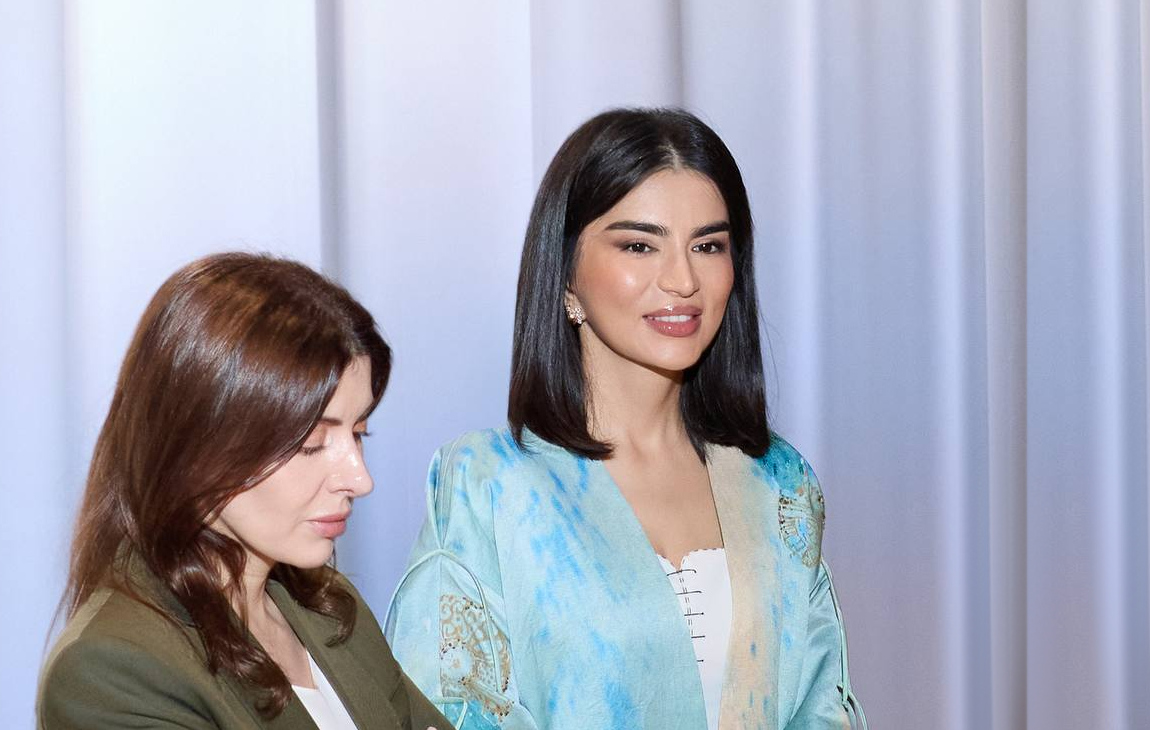
 Pictured: Saida Mirziyoyeva (right) and Gayane Umerova
On May 9, the 61st International Art Exhibition — La Biennale di Venezia — opened inside the historic Arsenale in Venice. The Republic of Uzbekistan is no newcomer to the event, and this year's vernissage was attended once again not by a routine culture official but by Saida Mirziyoyeva — the president's eldest daughter, head of the presidential administration, and, according to independent observers, the most likely successor to her father. She delivered the keynote at the inauguration of the Uzbek national pavilion, «The Aural Sea,» and it was her name that filled the headlines of every Tashkent outlet.
On paper, the pavilion is run by Gayane Umerova, chair of the Art and Culture Development Foundation of Uzbekistan and a seasoned art historian. She has served as commissioner of the Uzbek pavilion at the Venice Biennale since 2021, launched the inaugural Bukhara Biennale (which drew more than a million visitors), secured a UNESCO session in Samarkand, and was awarded France's Order of Arts and Letters in April 2025.
Yet at the vernissage, the leading figure was not Gayane but Saida.
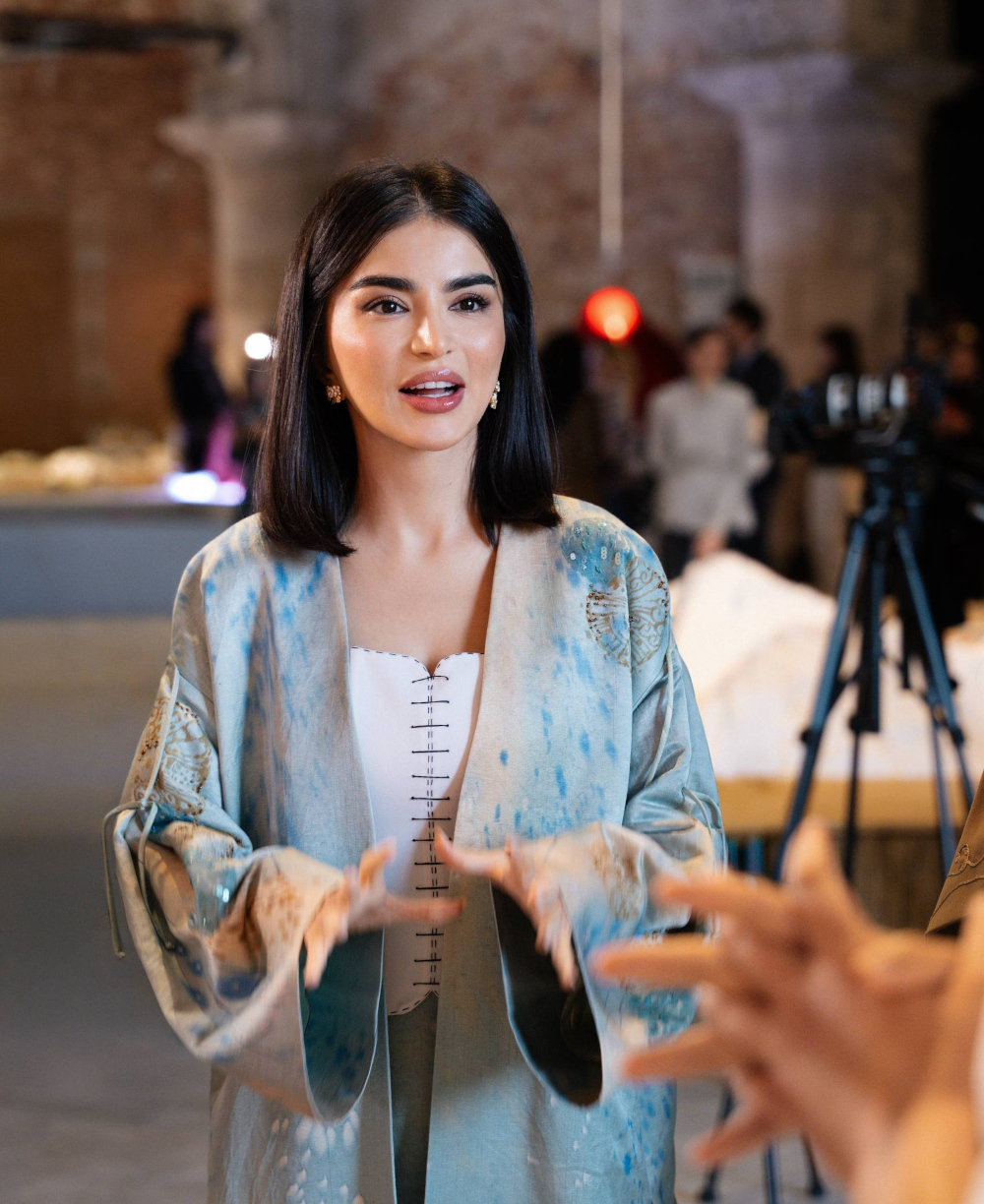 Pictured: Saida Mirziyoyeva. Photo from her Telegram channel.
ℹ️ Saida Mirziyoyeva entered government service in 2019, at age 34, three years after her father became president — and with no prior political experience. In six years she has made a dizzying ascent: from deputy head of the Agency for Information and Mass Communications to chief of the presidential administration, in effect the second most powerful figure in the country.
Analysts at the Carnegie Endowment write that the president has «come to rely on his family,» and that Saida Mirziyoyeva is now «considerably more powerful than any cabinet minister."
Against that backdrop, her appearance at an art pavilion opening in Venice is less a cultural outing than part of a deliberate political positioning: Saida Mirziyoyeva as a modern, enlightened Uzbek statesperson at home in the world's cultural capitals.
A Fergana backgrounder:
Saida Mirziyoyeva has attended the openings of Venice Biennales since 2021 — making this her fourth appearance at such events, each time in a steadily elevated role.
▫️ 2021 — Architecture Biennale. Uzbekistan's debut. Saida was already on hand, though in a modest capacity. Deputy Prime Minister Aziz Abdukhakimov and several ministers spoke at the opening of the «Mahalla» pavilion. Saida was listed only as «deputy chair of the board of the Art and Culture Development Foundation» — with Gayane Umerova as her boss. Even so, the president's daughter addressed the audience.
▫️ 2022 — 59th Art Biennale. Uzbekistan's first appearance at the art biennale itself, with the project «Dixit Algorizmi.» Saida traveled to Venice again and once more delivered remarks, still introduced as «deputy chair of the foundation's board."
▫️ 2024 — 60th Art Biennale. By then Saida carried the title of «assistant to the president of Uzbekistan» and was present at the opening of the pavilion «Don't Miss the Cue» at the Arsenale. The pavilion's official credits listed her as providing «special support» to the project, while Gayane Umerova remained commissioner.
▫️ 2026 — 61st Art Biennale. The current opening of «The Aural Sea,» where Mirziyoyeva appears in the capacity of chief of the presidential administration.
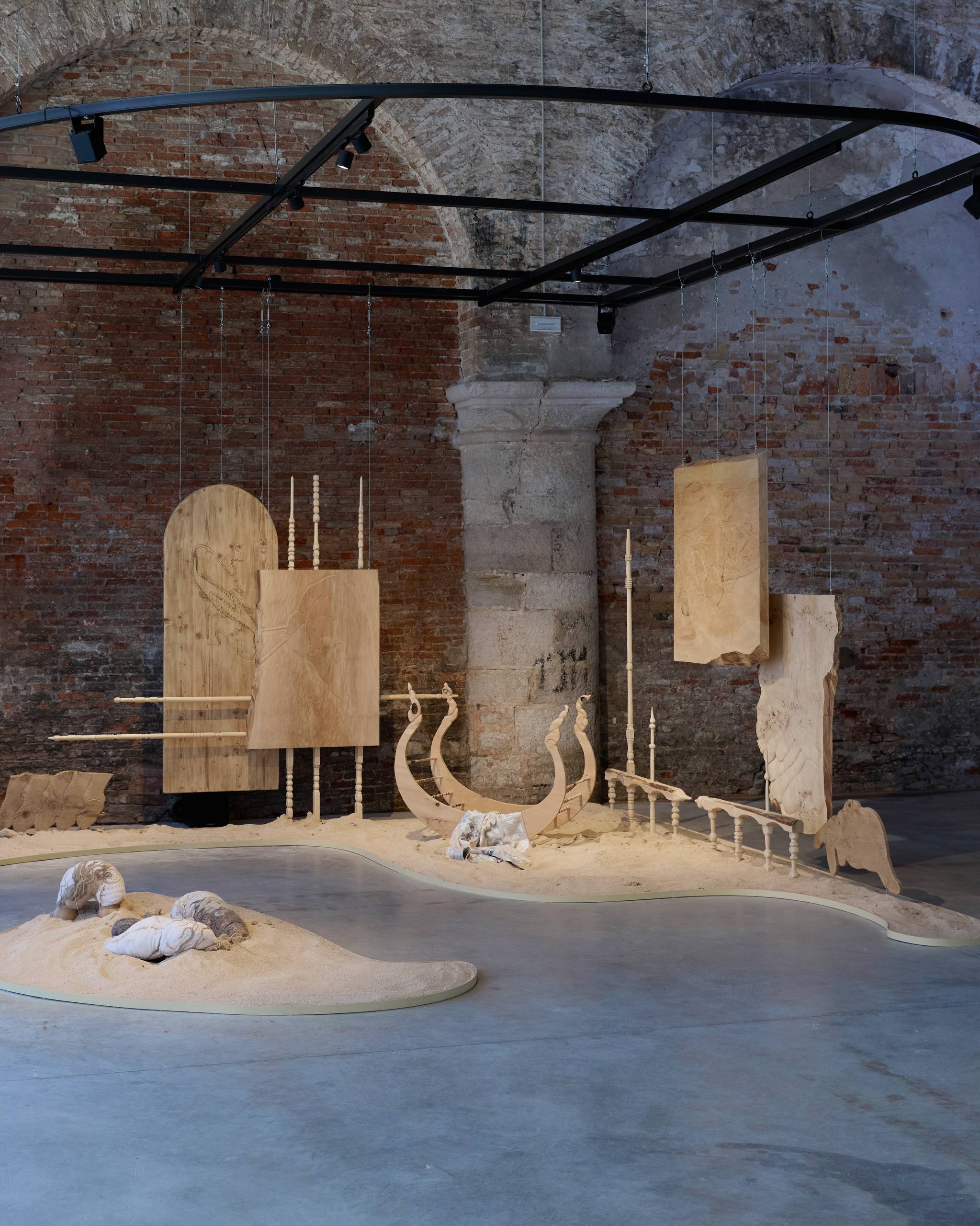 Pictured: a view of the Uzbek pavilion. Photo from Saida Mirziyoyeva's Telegram channel.
The artistic content of the Uzbek pavilion deserves a separate conversation.
«The Aural Sea» is devoted to the Aral Sea — one of the great ecological catastrophes of the 20th century, the product of Soviet irrigation policies in the 1960s that wiped out more than 90 percent of what was once an enormous inland lake and turned vast stretches of the autonomous Republic of Karakalpakstan, within Uzbekistan, into desert.
The curatorial team is made up of the first graduates of the Bukhara Biennale Curatorial School — another initiative of Umerova's foundation: Aziza Izamova and Kamila Mukhitdinova from Uzbekistan, Sophie Mayuko Arni from Switzerland, Nico Sun from China and Thai Ha from Vietnam.
The exhibition features seven artists: Jakhongir Bobokulov (b. 1996, Uzbekistan), Zee Kahramonova (2001, Uzbekistan), Aigul Sarsen (2005, Karakalpakstan), Zulfiya Spowart (1991, Uzbekistan), Xin Liu (1991, China), the British-Japanese collective A.A. Murakami, and Nguyen Phuong Linh (1985, Vietnam). The youth and international makeup of the team is clearly an image play, designed to project an Uzbekistan that is open and modern.
Rather than tackling the ecological disaster head-on, the artists explore the memory of it — through myth-making inspired by the Karakalpak writer Allayar Darmenov, who since 2015 has been «reviving» the Aral in his prose.
In parallel, the Palazzo Franchetti hosts «Instruments of the Mind,» a Vyacheslav Akhunov retrospective — an official collateral event of the Biennale, organized by Tashkent's Centre for Contemporary Art at the initiative of, once again, Gayane Umerova. It spans nearly five decades of work by one of the founders of conceptualism in Central Asia.
Akhunov, born in 1948 in Osh, was shaped by the Moscow conceptualism of the 1970s and has shown at Documenta 13 in Kassel and at biennales in Singapore, Montreal, Moscow and Venice. At the Palazzo Franchetti, several works conceived in the 1970s and surviving only as sketches for more than half a century are on view for the first time — paintings, drawings, video art and installations probing memory, language and resistance.
The Akhunov show is a genuine artistic event, capable of drawing serious international criticism. Yet in official Uzbek messaging, real artistic achievement is eclipsed by courtly ritual.
Tashkent media report above all that Saida Mirziyoyeva «spoke,» «attended» and «noted,» and that «the Uzbek pavilion once again drew great interest.»
☝️ Left out of the frame are the harder questions: how can a country whose government violently suppressed protests in Karakalpakstan in 2022, without anyone being held to account, now present that very region as «a space of memory, mythology and artistic reflection»?
Is an exhibition about the Aral Sea, curated by a state-run foundation, a way of steering international attention away from political repression and toward ecological lyricism?
And whom, in the end, does this elegant gesture serve — the people of Karakalpakstan, or the career of the president's daughter?
Art, of course, can and should address ecological tragedies. But when the headline exhibit of a national pavilion is not an artist but the head of the presidential administration, the show becomes a stage set for a family political project.
Why has the Venice Biennale become a shop window for Uzbek political alchemy — the kind that turns dynastic calculation into a cultural manifesto? The answer is straightforward.
If Shavkat Mirziyoyev is indeed betting on his daughter as successor, he needs something with which to justify that choice to an enlightened West.
By turning up regularly at biennale openings in Venice — a city where, since the 14th century, ambassadors, merchants and rulers have gathered to impress one another — Saida Mirziyoyeva is methodically constructing the image of an enlightened, European-style politician: she speaks of ecological disasters and Aral mythologies, intones «minor keys,» and poses against contemporary art — all so that one day, when her father hands her power, Western chancelleries will not choke on the word «nepotism»* but will fondly recall the pleasant young woman they once saw at the Arsenale, surrounded by artists.
*Nepotism — the practice of favoring relatives or close friends in appointments or the allocation of benefits, regardless of their actual merit or qualifications.
-
 17 April17.04Soft power with a rifle on its backWhat lies behind Kiriyenko’s visit to Uzbekistan?
 -
 08 April08.04World Football Needs a Forced RebootAlisher Aminov on Italy's failure, Michel Platini, the «Iran case» and chaos at FIFA
 -
 14 February14.02From Revolution to Rupture?Why Kyrgyzstan Dismissed an Influential “Gray Cardinal” and What May Follow
 -
 05 February05.02The “Guardian” of Old Tashkent Has Passed AwayRenowned local historian and popularizer of Uzbekistan’s history Boris Anatolyevich Golender dies
 -
 23 December23.12PhotoTokyo DriveJapan to invest about $20 billion in projects across Central Asia over five years
 -
 17 December17.12Sake for SixCentral Asia’s Rapprochement with Japan Comes with Hidden Pitfalls
-
Russian Scientists Revive the Plan to Irrigate Central Asia Using Siberian Rivers
-

Uzbek filmmaker Rashid Malikov on his new film, a medieval threat, and the wages of filmmakers
-
What has Samarkand accomplished in its three thousand years of existence?
-
Russia Approves New Migration Policy for 2026–2030