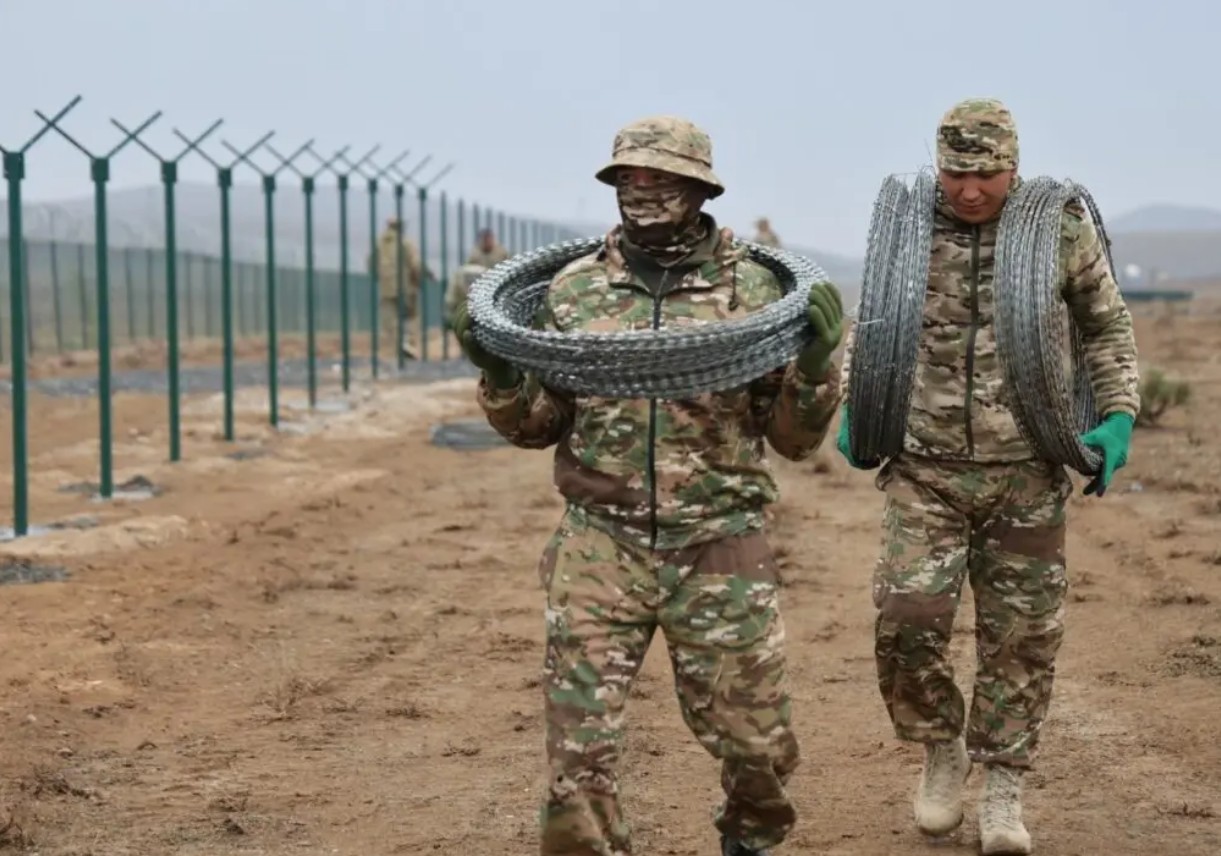
 The border. Photo from kg.akipress.org
Kyrgyzstan has largely finished fencing its border with Tajikistan in Batken Region, and the work marks the end of one of Central Asia's most dangerous territorial disputes. The new frontier replaces a patchwork of shared roads, canals and markets with a hard line.
Kyrgyz officials announced on October 17, 2026 that the main work on installing fences along the Kyrgyz–Tajik border in Batken Region was complete. Over two years, 327.7 kilometers (204 miles) of border barriers and 338.5 kilometers of field roads have appeared in Kyrgyzstan's Batken and Leilek districts. Not long ago, people in these areas argued over who owned a few meters of land, or who had the right to lay a water pipe or use a road. In 2021 and 2022, such disputes escalated into armed conflicts that left dozens dead and tens of thousands of people displaced.
The former patchwork border is gradually becoming an ordinary state frontier, with posts, fences, checkpoints and clearly separated territory. But the end of a decades-long dispute does not mean a return to the old way of life. Tajik and Kyrgyz villagers used the same roads, markets, canals and pastures for decades, and now a rigid line runs between them.
Kyrgyzstan installed 149.6 kilometers of fencing in 2025. From March to mid-September 2026, it added another 178.1 kilometers. Crews also built roads to reach remote sections of the border and to move border guards and equipment. They worked on flat terrain as well as in mountainous, high-altitude areas. Kyrgyzstan's Border Service has declared the engineering work on the Tajik section in Batken Region complete. Similar work in Osh Region is still under way.
Physical demarcation is also continuing on the Tajik side. In July 2026, Orif Khojazoda, chairman of Tajikistan's Committee for Land Management and Geodesy, said that work to define and mark the line was about 90% complete. He told Radio Ozodi (the Tajik service of Radio Free Europe/Radio Liberty) that the most difficult sections in Sughd Region had already been covered. He expects the engineering work to be fully finished in 2027.
The scale of the fencing would have seemed almost unimaginable not long ago. For most of the post-Soviet period, the Kyrgyz–Tajik border was hard to locate in many places. A house could belong to one country and the field next to it to another. The road between them might cross land that both sides claimed.
Land That Could Not Be Divided
In Soviet times, the line now separating the two states divided two union republics. It mattered far less in the daily lives of residents of the Isfara Valley, a densely populated area in the Fergana Valley region. Farms used their neighbors' land, canals and roads crossed the line, and pastures were allocated mainly on practical grounds. Infrastructure was built as if within a single state, with no thought that the administrative line might one day become an international border.
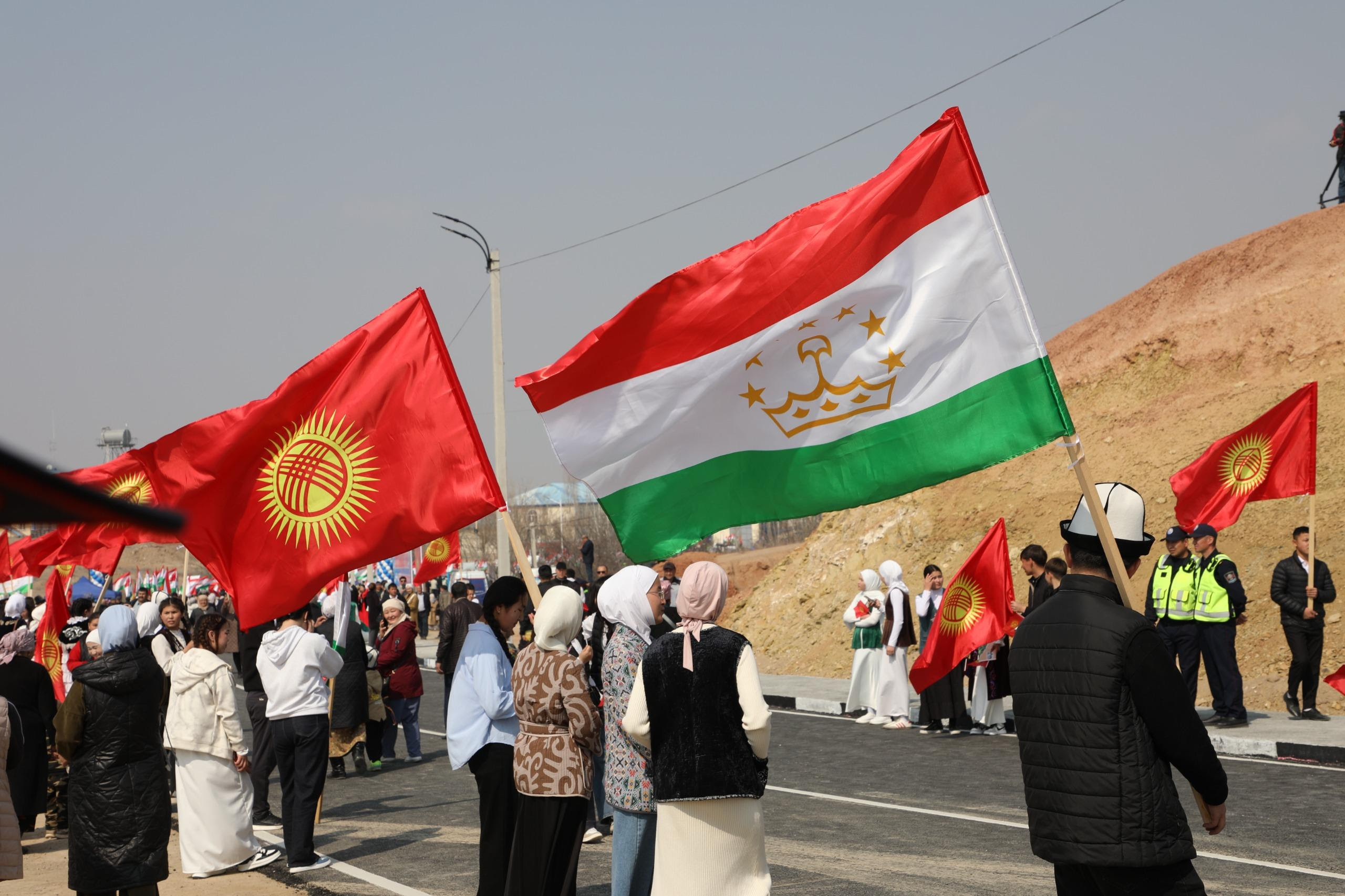 The opening of a checkpoint. Photo: Kyrgyzstan's Interior Ministry
After the USSR collapsed, it emerged that Bishkek and Dushanbe read Soviet-era documents and maps differently. As Carnegie Endowment researchers noted, each newly independent state tried to resolve discrepancies between old maps in its own favor. In February 2025, Kamchybek Tashiev, who was then head of Kyrgyzstan's State Committee for National Security, said that the Tajik side insisted on documents from the 1920s. Bishkek, he said, proposed relying in part on documents from 1991.
The dispute was not only about large territories. Roads, canals, water intakes, pastures and even strips of land between neighboring houses were all contested. In such a crowded valley, drawing a border without disrupting everyday life is practically impossible.
As early as 2014, British anthropologist Madeleine Reeves, who has studied the borderlands for many years, described the area as a single socio-economic space. Residents of Tajik and Kyrgyz villages traded at the same markets and paid in both Tajik somoni and Kyrgyz som. On some routes, buses crossed the administrative line several times. The whole valley depended on the Isfara River and its network of canals, while roads linked people to district centers and to mountain pastures.
This interdependence was especially clear around Vorukh, a Tajik exclave surrounded by Kyrgyz territory. The road from Vorukh to the Tajik town of Isfara ran through Kyrgyz land. Links between some Kyrgyz settlements, in turn, depended on roads crossing land the Tajik side considered its own.
In calm periods, this forced neighbors to negotiate. During flare-ups, it became a means of pressure: a road could be blocked, construction halted, or access to water or pasture restricted. A household dispute between a few residents often grew quickly into a conflict between two villages. Then border guards and later state agencies were drawn in.
Water was the most dangerous issue. In late April 2021, a clash over the Golovnoy water distribution facility escalated into a large-scale armed conflict. Human Rights Watch calculated that more than 50 people were killed in two days, most of them civilians. Hundreds were wounded, and about 58,000 people on both sides fled their homes or were evacuated.
A more severe escalation followed in September 2022. For four days, the two sides used artillery and armored vehicles, and Kyrgyzstan also used armed drones. Human Rights Watch documented the deaths of at least 37 civilians, including five children. Based on official lists and media reports, civilian deaths could have reached 51. In Kyrgyzstan alone, about 130,000 people were forced to leave their homes.
After that, preserving the old ambiguity became too dangerous for both countries. Negotiations intensified sharply, although much of their content stayed secret. By the end of 2024, the sides announced that they had finished agreeing on the remaining disputed sections. In February 2025, they began to disclose details of the compromise.
On March 13, 2025, Kyrgyz President Sadyr Japarov and Tajik President Emomali Rahmon signed a state border treaty in Bishkek. The countries also concluded agreements on the use of roads, water management and energy facilities, and on cooperation in agriculture and other areas. The border had been defined on paper. A far harder process then began: transferring that line to the ground.
The official length of the border is now 1,008.14 kilometers. Another 14.07 kilometers make up the perimeter of land plots with neutral status. On July 14, 2026, the two countries began jointly installing the first border posts.
Hectare for Hectare, Home for Home
To divide the territory, the two sides had to swap land as well as draw a line. In one of the largest exchanges, in Kyrgyzstan's Leilek district, Tajikistan handed over 190 hectares and received the same amount in return. Elsewhere, farmland, plots around roads and markets, and land near populated areas also changed hands.
The swaps did not always balance within a single parcel. Tajikistan gained 12 hectares containing a section of the Khujand–Kanibadam highway and the Dostuk market. Kyrgyzstan received 25 hectares of farmland near Lakkon. The Kyrgyz side published detailed terms of these arrangements before the final treaty was signed.
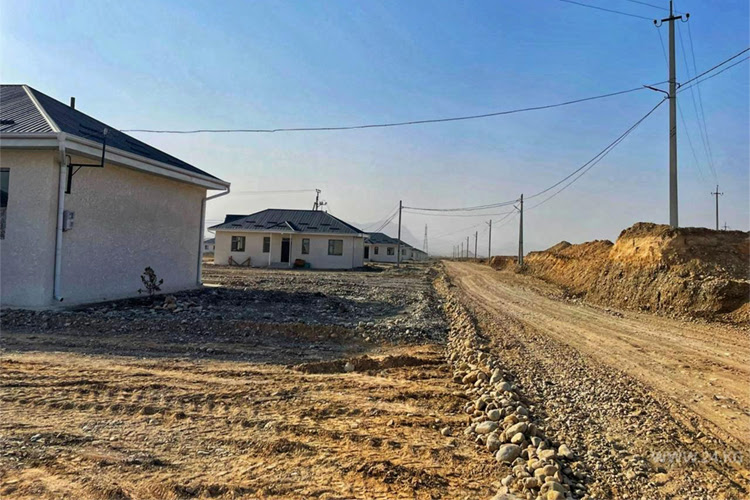 The village of Zhany Dostuk. Photo: 24.kg
Places where citizens of the two countries lived almost side by side proved especially sensitive. There it was impossible to draw a border between yards, and some people had to be relocated. One of the best-known examples is the Kyrgyz village of Dostuk, about 91 hectares of which became part of Tajikistan. For its residents and for families from several other areas, Kyrgyz authorities built a new village, Zhany Dostuk («New Dostuk»), on a 57-hectare site. In November 2025, 24.kg reported that 181 families, more than a thousand people, had moved there. They included residents of Dostuk and people resettled from Teskey, Mazeit, Tash-Tumshuk, Kok-Terek, Uch-Dobo and other areas affected by the exchange.
The new homes settled the question of property, but they did not make up for the lives people left behind. One resettled woman told journalists she had taken roses and spruce seedlings from her old home. Her family had lived off trade with Tajik neighbors and their own apricot orchard. They managed to harvest the crop before moving, but not to sell it.
A similar process took place on the Tajik side. In Khojai Alo, near Isfara, about 50 families handed over homes and land plots to Kyrgyz citizens and received property in territory that went to Tajikistan. In March 2026, some of them complained to Radio Ozodi that their new housing was much worse than what they had left.
Nusratullo Narziboev said his former home had eight rooms and stood on an 18-sotka plot (about 0.18 hectares). He considered the house he received in exchange unfit to live in. Other residents described dilapidated walls and the need to pay for repairs all over again.
Isfara authorities disputed these accounts. Acting city head Sharifjon Jumazoda said that only one or two formal complaints had been filed and that residents had agreed to the housing provided. He added that there is also dissatisfaction with the fairness of the exchange on the Kyrgyz side.
This is where the gap between state arithmetic and human arithmetic shows most clearly. At the negotiating table, a hectare can be offset by a hectare and a house by another house. For a family, that equality exists only on paper. What they lose is an orchard grown over decades, their neighbors, the familiar road to school, family graves and a place several generations called their own.
Resettlement is continuing beyond Zhany Dostuk. In late 2025, residents of some areas of the Leilek district began moving into new homes in Razzakov and Maksat. Under these programs alone, Kyrgyz authorities have built 181 houses in Zhany Dostuk, 60 in Razzakov and 16 in Maksat.
A Road of Their Own
After land, roads became the second key issue. For decades, some routes repeatedly passed from one republic's territory into the other's. While the border stayed relatively open, this was merely inconvenient. During conflicts, the road became a tool of pressure.
One of the best-known junctions is Tort-Kocho, where Kyrgyzstan's Osh–Razzakov highway meets the Isfara–Vorukh road. In past flare-ups, blocking this intersection could effectively cut off parts of Kyrgyzstan's Batken and Leilek districts. It could also complicate Vorukh's links with the rest of Tajikistan.
Under the new agreement, the intersection has neutral status and both sides are to use it on equal terms. Kyrgyz authorities reported that the same status is planned for two new bypass roads: Dacha–Kapchygai, for access to Vorukh, and Min-Oruk–Samarkandek, which the Kyrgyz side will use. Formally, these are not the territory of either state but specially designated neutral sections.
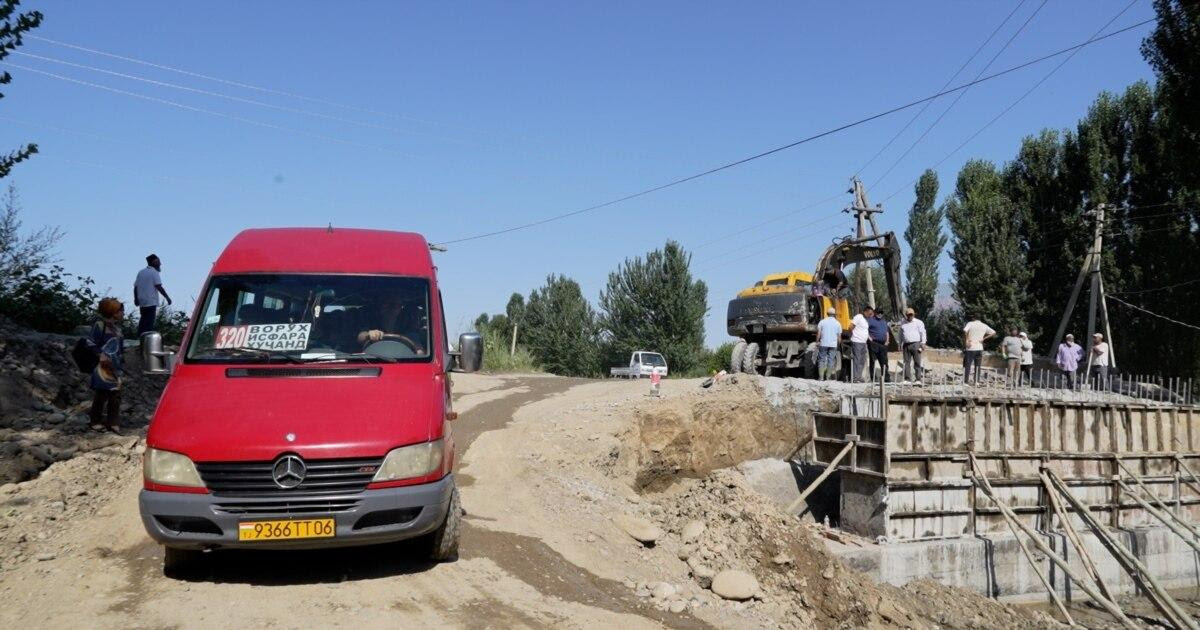 Construction of the new Khojai Alo–Vorukh road. Photo: Radio Ozodi
The most complex project involves Vorukh. Tajikistan is building a new section of the Khojai Alo–Vorukh road that will let vehicles bypass the Kyrgyz settlement of Kapchygai. It is about 4.2 kilometers long and 40 meters wide. Its cost is estimated at 255 million somoni, roughly $26 million.
Muzaffar Nosirzoda, head of the Sughd Region road administration, said the road must be built through mountainous terrain, partly by blasting rock. He expects it to open in about two years.
For Vorukh residents, the road is more than infrastructure. Throughout the conflict, traffic between the exclave and Isfara repeatedly became hostage to the latest escalation. As far back as July 2023, Fergana wrote about the road through Ak-Sai being blocked after a household dispute. Traffic resumed only after talks between border guards and local authorities.
Now the logic is changing. The shortest road used to be the most convenient, even if it crossed the administrative line many times. Today, a predictable route that neither side can close unilaterally matters more. In effect, each state is building infrastructure so that its residents' daily lives depend as little as possible on decisions made by the other.
An Open Border Behind a New Fence
At first glance, what is happening looks contradictory. Kyrgyzstan is walling off its territory with hundreds of kilometers of barriers, and the two countries are installing border posts and building separate routes. At the same time, they are reopening crossings and restoring trade. In fact, these are two parts of one process. Contacts are returning, but they now run through a clearly established border instead of an uncertain one.
On March 13, 2025, after a break of almost four years, two crossings, Gulistan–Kyzyl-Bel and Madaniyat–Kairagach, resumed operations. Hundreds of residents from both sides attended the opening. People hugged, cried and set out festive tables, and for the first time in years could freely meet relatives and neighbors.
A resident of the Batken district told journalists at the time that Kyrgyz and Tajik people here share not only traditions but even a market and a cemetery. That helps explain why the closure hurt the borderlands far more than it did people in the capitals.
In the first four days after the reopening, 4,891 people crossed the border. In July 2025, the presidents of the two countries also opened the Tojvaron–Karamyk crossing. It links Tajikistan's Lakhsh district with Kyrgyzstan's Chon-Alai district.
Trade is also coming back. In 2025, bilateral trade grew to $33.1 million, 2.7 times the previous year's level. Tajik exports to Kyrgyzstan exceeded $8.6 million, and imports from Kyrgyzstan reached $24.5 million.
Even after such rapid growth, trade has not returned to its 2020 level of about $37 million. It is even further from the $500 million target the two presidents spoke of after their reconciliation.
The old border economy has not fully recovered either. Before the closure, residents of both countries regularly traded at local markets, such as the Tuesday market in Kyrgyzstan's Arka and the Sunday market in Tajikistan's Khistevarz. As of March 2026, despite statements that they would reopen soon, neither market had resumed operations.
The cost of a closed border was especially visible in Kyrgyzstan's Kara-Bak. Before the conflict, buyers from Tajikistan and Uzbekistan came there to purchase livestock and apricots. After the crossings closed, that trade virtually vanished. Families became more dependent on farming, livestock breeding and remittances from relatives working abroad. Residents spoke about this shortly before the final border agreement.
Economic ties are slowly being restored, but the basis of neighborly relations has changed. Border life used to rest on constantly crossing a nearly invisible line. People went to the nearest market and used the most convenient road or canal, whichever republic's territory it lay in. That system connected neighbors, but it also produced endless grounds for dispute.
The new model works differently. There is the territory of one state and the territory of the other, with a physical border between them. Separate rules cover whatever cannot be fully divided: neutral roads, agreed access to water and official crossings. People can visit one another again, but only where and how Bishkek and Dushanbe have agreed.
In the year and a half since the treaty was signed, a disputed line on the map has begun to turn into a physical border of posts, roads and hundreds of kilometers of fencing. Getting there required land swaps, the relocation of families and the abandonment of some familiar routes. After the conflicts of 2021 and 2022, however, certainty has become the main condition for keeping neighborly disputes from escalating into armed confrontation again.
-
 20 October20.10Uzbekistan Sets Ambitious Goal to Train One Million Youth Annually in Robotics and TechUzbekistan aims to train 1M youth annually in robotics and game development, targeting 500,000 new tech jobs. Discover its massive digital education plan.
-
 17 September17.09Summit of Morning FreshnessCritical minerals, artificial intelligence — what else was discussed at the “Central Asia–Korea” meeting
-
 02 September02.09Who Are You, Mr. Vice President?From Analyst to Kazakhstan's Second-in-Command: How Erlan Karin's Views Have Evolved
-
 01 September01.09Just Look, Don't Say You Didn't SeeAn Islamic civilization media forum in Tashkent gathered over 300 journalists from nearly 50 countries
-
 30 August30.08The Real Intrigue Comes LaterObservers and experts assess Kazakhstan’s first elections to the new Kurultai parliament
-
 21 August21.08Elections to a Weakened KurultaiBerit Lindeman, Secretary General of the Norwegian Helsinki Committee, on democracy and the parliamentary campaign in Kazakhstan
-
Human rights defender and journalist Farid Tukhbatullin on the past, present, and future of the Turkmen people
-
The world's tallest dam is being built in Tajikistan on empty reserves and other people's loans
-
While Emomali Rahmon receives an honorary certificate “from the UN”, the Amu Darya keeps running shallow…
-
What lies behind Kiriyenko’s visit to Uzbekistan?