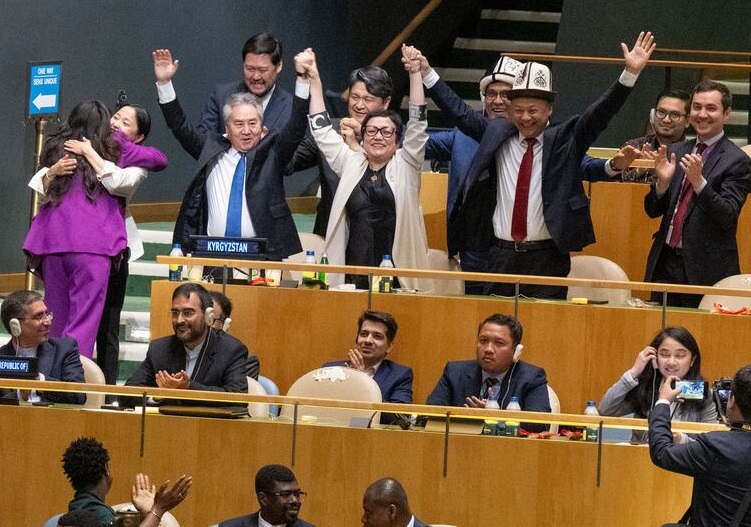
Kyrgyzstan has been elected a non-permanent member of the United Nations Security Council for the first time in its history. The result was announced after a vote held on June 3 during the 80th session of the UN General Assembly, according to the international organization's website.
The Central Asian republic was competing for a Security Council seat representing the Asia-Pacific region. To win, a country needed the backing of two-thirds of UN member states, or at least 127 votes.
At first, no candidate from the region cleared that threshold. The winner emerged only in the fourth round of voting: 142 General Assembly members voted for Kyrgyzstan, while 49 backed its chief rival, the Philippines.
The republic's representatives will begin their work on the Security Council on January 1, 2027, and will serve until the end of 2028. Kyrgyzstan takes over the seat held by Pakistan, currently a non-permanent member from the Asia-Pacific region.
After the results were announced, the president of the Central Asian country, Sadyr Japarov, congratulated his compatriots on the victory.
«We will help write a new page in the history of the UN,» the head of state said.
The campaign behind Kyrgyzstan's candidacy began back in 2025 with an official reception at UN headquarters in New York, attended by diplomats from more than 150 countries. At the time, the republic's Foreign Ministry set out Bishkek's priorities should it win a Security Council seat: conflict prevention, disarmament, support for small and developing states, and stabilization in Afghanistan.
The Foreign Ministry stressed that more than 60 UN members have never sat on the Security Council, while some countries have been elected five or six times. Pointing to this imbalance, Kyrgyzstan framed its candidacy as a step toward fairer representation.
The Central Asian candidate was backed by all its regional neighbors. Kyrgyzstan is not, however, the first Central Asian country to serve as a non-permanent member of the Security Council. Kazakhstan held a seat on the body in 2017-2018.
In the same June 3 vote, Austria, Zimbabwe, Portugal, and Trinidad and Tobago also won the right to join the Security Council. These states will replace Pakistan, Greece, Somalia, Denmark, and Panama, respectively, whose mandates expire on December 31, 2026.
The Security Council is one of the six principal organs of the UN and the only one whose decisions are legally binding. It can impose sanctions and authorize the use of military force to maintain or restore international peace and security.
The council comprises 15 states: five permanent members with veto power — the United States, the United Kingdom, France, Russia, and China — and 10 non-permanent members elected to two-year terms based on regional representation.