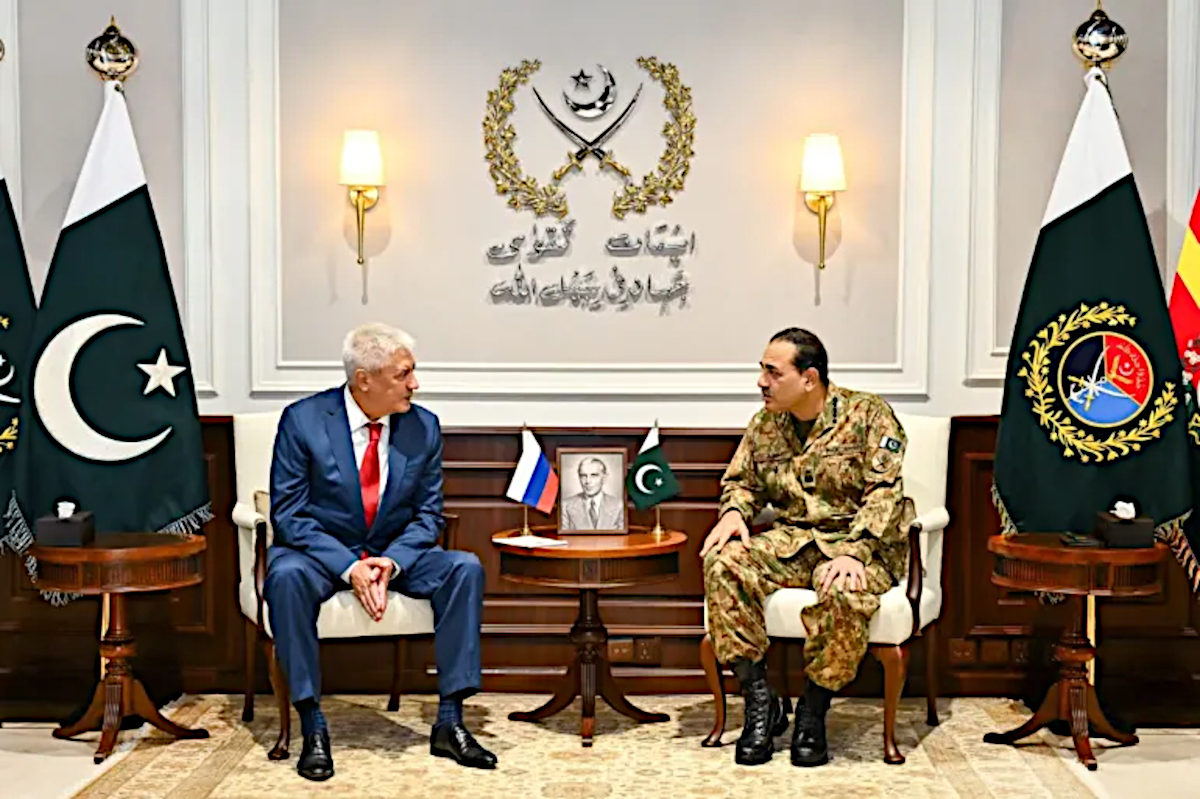
 Russian Interior Minister Vladimir Kolokoltsev meets Field Marshal Asim Munir, chief of the General Staff of Pakistan's armed forces, in Rawalpindi, October 14, 2026.
Russia has stepped up contacts with Afghanistan and Pakistan amid worsening relations between the two countries. According to an analysis published by Al Jazeera on October 16, the simultaneous visits of senior Russian officials to Kabul and Islamabad may signal Moscow's desire to help resolve the conflict.
On October 14, Sergei Naryshkin, director of Russia's Foreign Intelligence Service, met in Kabul with Abdul Haq Wasiq, head of the Taliban administration's General Directorate of Intelligence. The same day, Russian Interior Minister Vladimir Kolokoltsev held talks in the Pakistani city of Rawalpindi with Pakistan's military chief, Asim Munir.
Official reports on the meetings gave few details about the issues discussed. Russian and Afghan officials did not disclose what Naryshkin and the Taliban intelligence chief talked about. The Pakistani side said the meeting between Kolokoltsev and Munir focused on bilateral security cooperation and the regional situation.
Al Jazeera assesses that Moscow may try to use its strengthened ties with both sides to help ease tensions. Earlier, Zamir Kabulov, the Russian president's special representative for Afghanistan, told TASS that Moscow is ready to act as a mediator between Kabul and Islamabad if both sides request it.
Pakistan's Ambassador to Russia, Faisal Niaz Tirmizi, said in March that Islamabad had already approached Moscow on the matter. The Taliban, however, have not publicly asked Russia to mediate, Al Jazeera notes.
A previous attempt to make progress at talks in Moscow on October 5 produced no tangible results. One of the sticking points was the wording on terrorism. Pakistan views the activities of armed groups, including Tehrik-i-Taliban Pakistan (TTP), as one of the main threats to its security and accuses the Afghan authorities of giving them shelter. The Taliban reject accusations that they allow Afghan territory to be used for attacks on other countries.
Fergana analysts point out that Moscow's diplomatic capabilities should not be confused with real influence over the parties to the conflict. Russia maintains relations with both the Taliban administration and the Pakistani leadership, but this in itself does not guarantee that Kabul and Islamabad are ready to compromise. Earlier mediation efforts by Qatar, Turkey and China also failed to bring about a lasting end to the clashes.
Moscow also has its own interests in the region. Russian authorities are concerned about the threat posed by the Afghan affiliate of the Islamic State, an organization banned in Russia. Moscow views security cooperation with the Taliban partly as a way to counter this threat and reduce the risk of armed violence spreading to Central Asia.
At the same time, pressing the Taliban to take action against the TTP could complicate Moscow's relations with Kabul. As Al Jazeera notes, citing experts, Russia publicly focuses on the threat from the Afghan affiliate of the Islamic State, while Moscow's willingness to demand concrete action from the Taliban against Pakistani armed groups remains unclear.
Thus, the visits by Russian officials may indicate that Moscow wants to expand its diplomatic options in the region. However, there is so far no confirmation that Naryshkin brought a specific settlement plan to Kabul or that the parties have agreed to new talks. Russia's potential mediating role will depend primarily on whether Afghanistan and Pakistan can agree on the terms of a dialogue.